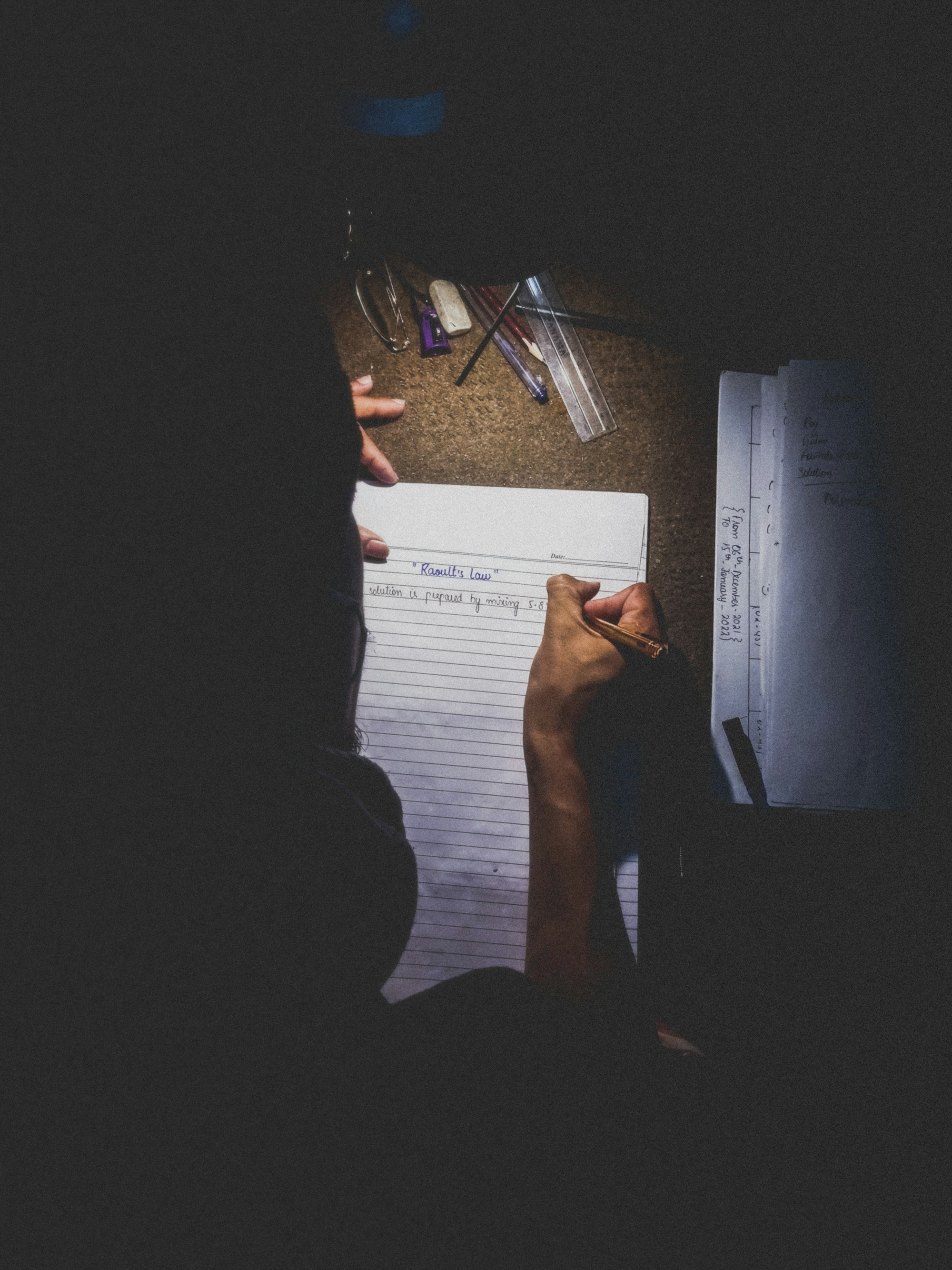

Short answer, folks: you focus better while studying when the phone is out of the room, when you quiz yourself instead of rereading, and when you take your breaks on a timer before your brain takes them for you. Sleep and the timing of your coffee do the rest. None of it comes in a capsule, and most of it costs nothing.
Quick note before we start. I’m not a doctor, and this isn’t medical advice. If you can’t focus no matter what you try, in class and at home, for weeks on end, that’s worth a talk with your doctor. A study habit can’t fix a sleep problem, a low mood or anything else going on underneath.
Here’s what’s coming up:
- what a phone on the desk may do to your focus, and why the research is split on it
- the two study methods a big 2013 review rated highest
- how long to study before a break, from a 2023 trial with students
- why sleep and coffee timing belong on your study plan
- a short walk, music with lyrics, and when it’s time to call your doctor
Put the Phone in Another Room

In 2017, a team led by Adrian Ward at the University of Texas ran experiments with nearly 800 smartphone users. Some left their phone on the desk, face down. Some kept it in a pocket or a bag. The rest left it in another room. The people whose phones sat in the other room did significantly better on the tests than the people with a phone on the desk, and a little better than the pocket-and-bag group. On or off, face up or face down, it made no difference. Just having it there was the problem, the authors argued.
Now the honest part. In 2022, two researchers at Western University in Canada repeated Ward’s second experiment with the same tasks, and they registered their plan before they started. They found no difference at all between the desk, the bag and the other room. So the “brain drain” effect may be smaller than the first paper made it look, or it may not be there.
I’d still move the phone. Even if its mere presence does nothing, a phone on the desk is a phone you’ll pick up, and every buzz you check is a restart. Walking it to the kitchen takes ten seconds. That’s the cheapest experiment you’ll ever run on yourself.
Quiz Yourself Instead of Rereading

This is the big one. In 2013, John Dunlosky of Kent State University and four other researchers reviewed the evidence for ten study techniques students use all the time. Two got the highest rating: practice testing and distributed practice. Five got a low rating, and they included some of the most popular habits around: highlighting, rereading and summarizing.
Practice testing sounds fancier than it is. It’s flashcards. It’s covering your notes and saying the answer out loud. It’s doing the questions at the end of the chapter before you look anything up. Dunlosky put it plainly when the review came out: students would benefit just by replacing rereading with delayed retrieval practice.
So why does rereading feel so productive? Because the page looks familiar the second time, and familiar feels a lot like knowing. Then the exam asks you to pull the answer out of your own head with no page in front of you. That’s a different skill. Quizzing yourself practices the exact thing you’ll be asked to do.
One tip: try to answer first, then check. Getting it wrong and then seeing the right answer feels worse in the moment. That’s kinda the point.
Spread the Same Hours Over Several Days

Distributed practice is the other method that topped that 2013 review. It just means spacing your study out: the same total hours on a different calendar. Every time you come back to the material after a gap, you have to dig it up again, and the digging is what makes it stick.
Cramming isn’t useless, honestly. It can get you through tomorrow morning. The trouble shows up a week later, when the final asks about chapter two again and it’s gone.
The easy version goes like this. When you get a test date, count back and put two or three short review sessions on the calendar before it. Start each one with a quick self-quiz on the old material before you open anything new. That way you’re spacing and testing at the same time, and you’ve stacked the two methods the review liked best.
Take the Break Before Your Brain Takes It

The Pomodoro technique is the famous one: study for a set block, break for a few minutes, repeat. Turns out there’s a real trial of it with students. In 2023, a team at Maastricht University split 87 university students into three groups for a day of self-study. One group took a 6-minute break after every 24 minutes of work. Another took 3 minutes after every 12. The third group decided for themselves.
The students who chose their own breaks studied longer and took longer breaks. They also reported more fatigue and more distraction, and less concentration and motivation, than the timer groups did. And here’s the kicker: all three groups got about the same amount of work done. The timer groups just did it in less time.
That’s one small trial, one day, one university, so I wouldn’t treat 24 and 6 as magic numbers. A round every 30 minutes is simply easy to remember. What the study does suggest is that deciding the break in advance beats deciding it when you’re already fried. Set the timer, and when it rings, stand up.
Sleep Is Part of the Study Plan

The CDC puts teens 13 to 17 at 8 to 10 hours of sleep a night, and adults at 7 hours or more. Exam week is usually when those numbers go first.
That’s backwards. The National Heart, Lung, and Blood Institute says it in plain words: while you sleep, your brain is forming new pathways to help you learn and remember information. It also lists what sleep deficiency does to you, and the list reads like a bad exam day. Trouble learning, focusing, remembering things and solving problems, slower reactions, more mistakes.
So if you have to choose between one more hour of review and one more hour of sleep the night before a test, take the sleep. You’ll do tomorrow’s quick review better on a rested brain anyway.
Time the Coffee So It Doesn’t Cost You Sleep

Caffeine does help alertness. That part’s settled. The problem is when you drink it. In a 2013 study from the sleep center at Henry Ford Hospital in Detroit, 12 healthy sleepers took caffeine at bedtime, 3 hours before bed or 6 hours before bed, with placebo pills on the other slots. All three timings disturbed their sleep. Even at 6 hours, measured sleep time dropped by more than an hour, and the sleepers’ own diaries suggested they hadn’t noticed.
The study used 400 mg, which is a lot. The American Academy of Sleep Medicine described it as about 2 to 3 cups of coffee, and it’s the same number the FDA gives as a whole day’s amount for most healthy adults. A single coffee will hit you less hard. The lesson still holds, though. If you study until 11 at night, an energy drink at 5 is sitting right inside that 6-hour window.
So have it early, and count all of it: the coffee, the tea, the soda and the “focus” can on the label. If you’re pregnant, on medication, or caffeine makes your heart race, ask your doctor what’s right for you.
READ: Is There Caffeine in Nootropics?
Walk for 20 Minutes Before You Sit Down

In a 2009 study at the University of Illinois, 20 kids around 9 years old walked on a treadmill for 20 minutes at a moderate pace. Afterward they were more accurate on an attention test and scored better on reading comprehension than after a session of rest. Spelling and arithmetic didn’t change.
That’s 20 kids and one session, and they were 9. It’s no proof that a walk makes a college student sharper. But a brisk walk before a study block is free, it gets you away from the screen, and it has decent company in the research. I’d call it worth a shot, especially before the hardest subject of the day.
Keep the Lyrics Out of Your Ears

Music while studying is the habit people defend the hardest. Here’s what the research says. A 2014 study at Cardiff Metropolitan University in Wales had people take a reading comprehension test in silence or with different kinds of music. Scores were best in quiet. Music with lyrics hurt more than music without, whether people liked the songs or not.
A 2023 study that tracked people’s reading found instrumental music didn’t really distract them, while song lyrics did, though the effect was mild. Makes sense when you think about it. Words in your ears compete with the words on the page.
So if you need sound to get going, pick music with no words, or just some steady background noise. Save the playlist you sing along to for the walk.
When Focus Trouble Is Bigger Than Your Habits

Habits fix habit problems. They don’t fix everything. If you can’t focus anywhere, in class, at work and at home, and it’s been going on for months, take that to your doctor. Same if you snore and wake up tired, or if your mood has been low for a while. A study timer can’t sort those out, and nobody should try to self-treat them with a supplement.
You might expect a nootropics guy to point you to a stack at this point. Not first. When you line the label up against the amounts the studies used, most study supplements come up short, and none of them beats a phone in another room. Get the free stuff right. If you’re still curious after that, read the stack post below, and run anything you plan to take past your doctor.
READ: Best Nootropic Stack for Studying & Learning
Conclusion

The whole plan fits on one line: phone in the other room, quiz yourself, space it out, break on a timer, sleep, coffee early, and music without words if any. Give it four weeks before you judge it, and change one thing at a time, so you can tell which one helped.
Want a number to compare? Take the free memory and attention tests here before you start and again four weeks in. And if one of these habits did nothing for you, tell me in the comments. I write back. That would be it, folks!