Thesis Nootropics: This Is What I Think — My Review
Thesis sent me the Clarity blend after I told their quiz I wanted to focus. Which is what everyone tells the quiz. Which is probably why Clarity is always sold out.
I’m not a doctor. Said it. Moving on.
What I am is a person who spent roughly $1,100 on nootropics before I started keeping records, and the record-keeping changed everything. Four weeks minimum per compound. Sleep controlled. Caffeine flat. I write the verdict whether or not it’s interesting. Thesis got 60 days because I wanted to be fair to the personalization angle. Here’s what I found.
What Thesis Actually Costs When You Do the Math
Most reviews quote $119 as the monthly cost. That’s the starter kit: four blends, four servings each, 16 days of coverage total. Sixteen. Not thirty. The $119 is a one-time trial price and it’s kind of a bait number, because anyone who keeps using Thesis moves to the subscription at $79/month. That’s the number that actually matters for long-term use, and almost nobody writes it down.
To compare what these really cost a day rather than per bottle, the free cost per serving calculator does the arithmetic from the labels.
So: $79 per month, 16 usable days. That’s $4.94 per dose day. Compare that to building the core ingredients yourself. Alpha-GPC 300mg from Nootropics Depot runs about $0.79 per capsule retail. Lion’s Mane 8:1 extract 500mg is $19.99 for 60 capsules. Bacopa Synapsa 320mg is $14.99 for 60 capsules. A self-assembled stack covering 30 days costs you somewhere between $38 and $45 total, depending on what’s on sale.
Thesis is roughly 3x the cost of a self-assembled stack, and it covers half the month. The convenience premium is absolutely real. I’m not pretending otherwise. You get a box, a coaching call, blends pre-selected for you. But most reviewers don’t run this math and I think that’s a disservice, because the convenience argument lands very differently at $4.94 a day versus what people assume they’re paying.
The Six Blends and the Doses Thesis Won’t Publish
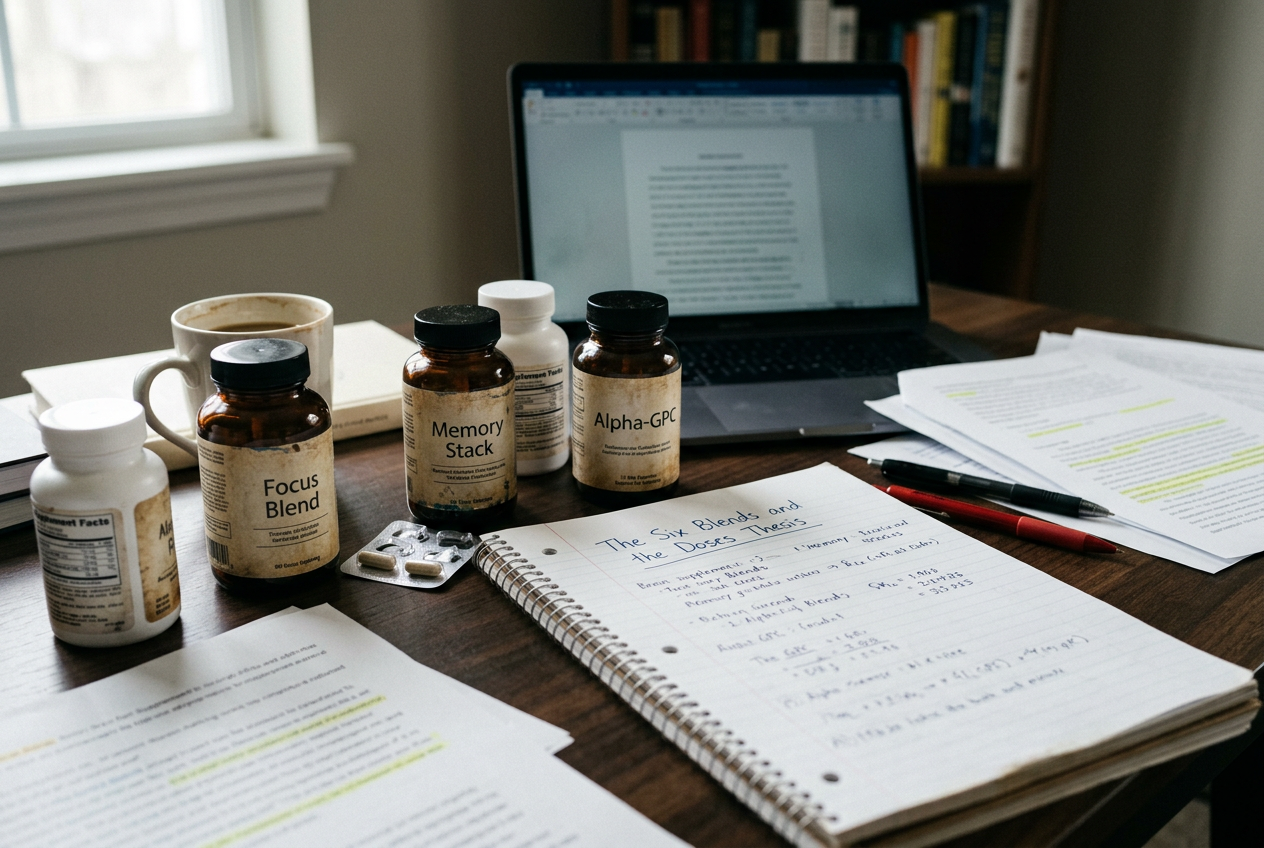
The six blends are Clarity, Logic, Motivation, Creativity, Confidence, and Energy. Each has a stated purpose. None of them, in most cases, tell you how much of anything you’re getting per serving.
Clarity contains Alpha-GPC, Lion’s Mane, Ashwagandha, and Zynamite. No individual milligram amounts listed. Logic contains Triacetylurea, Bacopa Monnieri, and Synapsa standardized extract, dose unlisted. This is proprietary blend labeling, and it is the single biggest problem with Thesis as a product.
Here’s why it matters. Alpha-GPC’s therapeutic dose range in the published literature is 300 to 600mg. Lion’s Mane in Mori et al.’s 2009 mild cognitive impairment study used 3 grams per day. If a Clarity serving contains 50mg of Alpha-GPC and 100mg of Lion’s Mane, which is entirely possible inside a proprietary blend, it contains ingredients that are associated with cognitive benefit, without containing the amounts that produced that benefit. The label looks good. The capsule doesn’t do much.
When a company won’t print individual doses, the most likely reason is that printing them would reveal they’re sub-therapeutic. That’s not me being cynical. That’s the standard manufacturing calculus: clinical doses of Lion’s Mane are expensive to source at 3g/day. 200mg is cheap. Both get listed as “Lion’s Mane” on the label. I’ve seen this move on probably a dozen supplement labels at this point (I learned to look for it the expensive way), and Thesis is not uniquely guilty of it. But they also charge a premium that implies they’re above it.
READ: My full Mind Lab Pro review
How the Personalization Quiz Actually Works — and Where It Breaks Down
The quiz takes about three minutes. It asks about your focus goals, sleep quality, stress levels, and caffeine sensitivity. It’s well-designed, warm in tone, and it absolutely creates a feeling like something is being tailored for you specifically.
There are six possible outputs. One per blend. That’s it.
There are no questions about your current medications. No questions about liver function. Nothing about your existing supplement stack. And, this one genuinely surprised me, no question about body weight, despite weight-dependent dosing being standard practice in pharmacology. A 130-pound person and a 220-pound person get the same recommendation if they answer the same five questions.
A real personalized stack would require bloodwork at minimum. At absolute minimum, a detailed intake history covering what you’ve already tried and how you responded. What Thesis built is a funnel that maps your answers to a pre-built product. The quiz creates the experience of personalization without the cost or liability of actually personalizing anything. I don’t think that’s a scandal, it’s smart marketing, but calling it personalization is doing a lot of work for what is functionally “pick one of six.”
The misconception worth correcting: that this makes Thesis different from just buying a pre-made stack off Amazon. It doesn’t, structurally. The difference is in ingredient quality and the coaching layer, not the quiz.
Ingredients That Hold Up vs. Ingredients That Don’t
Bacopa Monnieri holds up. Stough et al. 2001 used 300mg per day over 12 weeks and found significant improvements in verbal learning and memory consolidation. That study has been replicated in various forms. Twenty-plus years of human trials. If you want to know which ingredient in these blends has the most durable evidence behind it, it’s Bacopa, and it’s not particularly close.
Lion’s Mane holds up too, with caveats. The Mori et al. 2009 study used 3 grams daily in mild cognitive impairment patients. Thesis almost certainly isn’t hitting 3g, which doesn’t make it useless, but the dose question matters enormously with Lion’s Mane. It’s not a compound where “some is as good as more.”
Ashwagandha: the standardized form with the most evidence is KSM-66, studied at 300 to 600mg. If Thesis is using KSM-66 in Clarity, that’s a real ingredient choice. If they’re using generic ashwagandha root powder, the standardization is inconsistent and the evidence doesn’t really transfer. The label doesn’t tell you which it is. That bothers me.
Zynamite is Mangifera indica extract, basically a standardized mango leaf extract. Human studies exist. The largest I found had an n of 60. That’s not nothing, but it’s also not Bacopa. Triacetylurea, which shows up in Logic, has even thinner human data. These are promising compounds, potentially. Right now they’re mostly interesting, not proven.
Thesis would be a stronger product if it dropped the exotic stuff and put the budget into clinical doses of Bacopa and Lion’s Mane. The current formula reads like it was designed for the ingredient list on the marketing page, not for what would actually reach the bloodstream at effective concentrations. Newer and exotic doesn’t mean more effective. Bacopa is boring. Bacopa works.
Dose used in the researchDose in the product
READ: Mind Lab Pro Dosage: When to Take It (and When Two Capsules Is Wrong)
Side Effects I Noticed and Why They’re Not Random
Day two on Clarity, I got a headache that started behind my left eye around 2pm and sat there until I went to sleep. Day three, same thing, slightly less intense. I’ve run into this before with Alpha-GPC and it’s a recognizable pattern once you know what you’re looking at.
Alpha-GPC is a choline donor. It raises acetylcholine synthesis. If you’re already running at a naturally high acetylcholine level, or if you eat a lot of eggs, liver, or other choline-rich foods regularly, adding a significant Alpha-GPC dose can tip you into cholinergic excess. Headache is the primary symptom. Some people also get irritability or a kind of heavy, flat mood. Not quite depression, more like being mildly turned down.
Thesis’s FAQ suggests pushing through the adjustment period. I disagree with this pretty firmly. Headaches from cholinergic excess don’t resolve with adaptation. They’re a signal that you’re overshooting. Pushing through doesn’t recalibrate anything, it just continues the overshoot. The correct move if you hit this pattern is to back off Alpha-GPC, not wait it out. Switching to the caffeine-free version of the blend (which is available but is not the default and isn’t prominently marketed) didn’t help me personally because the issue wasn’t caffeine.
Logic gave me mild GI discomfort on days one and two. Nothing dramatic, just that low-level uneasy stomach that tells you something new is happening. That cleared up by day four.
One thing worth knowing for long-term users: ashwagandha has rare but documented hepatotoxicity cases in the literature at high doses. Not a Thesis-specific risk, and the doses here are likely low enough that it’s not a practical concern for most people. But if you’re planning to run this for six-plus months straight, it’s worth cycling off, which Thesis actually recommends anyway. Five days on, two days off is their suggested protocol, and I think the cycling advice is genuinely good.
Which Blend to Start With Based on What You’re Actually Trying to Fix
The blend names are the worst thing about Thesis. They describe the outcome you want, not what’s in the capsule. This sounds like a small complaint and it’s actually a significant usability problem.
If your issue is task initiation, you sit down to work and nothing happens, that’s a dopaminergic problem more than a cholinergic one. The Motivation blend contains Forskolin 250mg and Artichoke Extract, which is the CILTEP protocol that Abelard Lindsay popularized years ago. CILTEP works by inhibiting PDE4, which raises cAMP levels, which supports dopamine signaling. It’s a real mechanism and some people respond noticeably to it. You can also build the CILTEP stack yourself in singles for about $25 a month, which is worth knowing.
If your problem is word retrieval, you know what you want to say but it’s just not coming out, that’s more plausibly a cholinergic issue, and Clarity with its Alpha-GPC is the more logical starting point. That’s the one that did something for me, which I’ll get to in a minute.
If anxiety is the thing that’s actually killing your focus, please don’t buy the Energy blend. I know it sounds like it should help. Energy contains N-Acetyl L-Tyrosine 300mg and TeaCrine 100mg. That’s a stimulant stack, and it will make anxiety-driven distraction worse, not better. The Confidence blend contains Saffron as affron-branded extract at 28mg and Magnolia Bark 200mg. That’s an anxiolytic stack. “Confidence” is a much better fit for anxiety than the name suggests; “Energy” is exactly wrong. Thesis naming these for desired outcome rather than mechanism means people self-select into the wrong product constantly.
READ: How Long Does Mind Lab Pro Take to Work?
Thesis vs. the Three Competitors That Target the Same Buyer
I want to be concrete here because the comparison matters.
Mind Lab Pro costs $69/month. It has 11 ingredients. Every milligram is disclosed on the label: Citicoline 250mg, Lion’s Mane 500mg, Bacopa 150mg, and so on down the list. You can look up every ingredient against the literature and tell immediately whether the doses are in the studied range. Lion’s Mane at 500mg is below the Mori et al. 3g benchmark but it’s a real amount. Bacopa at 150mg is on the lower end of studied doses but it’s not homeopathic. Mind Lab Pro is the more intellectually honest product. It costs less than Thesis, discloses everything, and the formula hasn’t changed significantly in years because they built it around doses that actually work and didn’t need to keep tinkering.
Nooceptin comes in at $69/month as well. Lion’s Mane 400mg, Bacopa 150mg, Rhodiola 150mg, all published on the label. It’s a simpler formula than Mind Lab Pro, closer to a targeted stack. Also transparent. Also cheaper than Thesis.
Self-assembled from Nootropics Depot: Bacopa Synapsa 320mg at $14.99 for 60 capsules, Lion’s Mane 8:1 extract 500mg at $19.99 for 60 capsules. You’re at $34.98 a month for 60 days of both. You know exactly what you’re taking. You can adjust doses independently. The downside is it takes fifteen minutes of research to set up and you don’t get a box with your name on it.
The assumption that paying more for personalization produces better results isn’t supported by how these products are actually formulated. Fixed-formula products with disclosed clinical doses have a stronger evidence case. Period.
My Actual Verdict After 60 Days — What Changed and What Didn’t
Week one: nothing noticeable on either Clarity or Logic. This is normal with most nootropics and I don’t count week one for anything.
Week three on Clarity: I noticed something specific and I want to be specific about it. I write for work, actual writing, long documents and first drafts, and word retrieval is where I feel cognitive friction most acutely. By week three, that friction was measurably lower. I was reaching for words and finding them without the half-second delay I’d normalized. Whether that was Alpha-GPC, Lion’s Mane, or some confounding variable I didn’t catch, I can’t fully isolate. But it was real enough that I noticed it without looking for it, which is the test I use.
Logic: 30 days, nothing I could attribute to the blend specifically. No noticeable effect at the prescribed dose. I wanted it to work. It didn’t, for me, or at least not detectably.
Day 60 I had a 15-minute coaching call with a Thesis health coach. I used it once. It was fine, the person was friendly and clearly knowledgeable, but the conversation covered nothing a thorough FAQ wouldn’t cover. Blend rotation, cycling schedule, caffeine timing. Useful information, but not worth a line item if you’re being honest about value.
After the trial ended, I switched to standalone Bacopa Synapsa 320mg plus Lion’s Mane 500mg. Total cost: $34.98 a month. The word retrieval effect I got from Clarity has held. If anything it’s slightly more consistent now, which I attribute to knowing exactly what I’m taking and at what dose.
Thesis is a genuinely reasonable way to start exploring nootropics. It’s safe, the ingredient quality is above average compared to random Amazon brands, and trying four different formulas over 16 days is actually a decent discovery method. If Clarity does something for you and Logic doesn’t, that tells you something real about which ingredient classes your brain responds to.
But once you have that information, the personalization wrapper costs you about $40 a month and adds nothing. The rational move is to use Thesis as the discovery tool it actually is, then replicate whatever worked in single-ingredient form at confirmed doses. That’s what I did. That’s what I’d tell a friend to do.