I Almost Quit at Day 31 Because Nothing Had Changed
Then I read the dosing footnote on page 4 of the OptiNutra white paper and doubled my capsules. That’s the whole origin story of this post, honestly. Not some dramatic cognitive transformation. Just me, frustrated, sitting at my desk at 9pm with a half-empty bottle and a Google Doc that wasn’t getting any longer, wondering if I’d wasted another $69.
I’ve done this before. I spent something like $1,100 in a single year cycling through nootropics, and at the end of it I couldn’t point to one thing that had measurably changed. Racetams I bought from a gray-market vendor. A lion’s mane tincture that smelled like a forest floor and did approximately nothing. A choline supplement I took inconsistently because I kept forgetting it was there. I’ve been the exact person the supplement industry depends on: motivated enough to buy, inconsistent enough not to notice when something doesn’t work.
Mind Lab Pro was supposed to be different because I was going to do it properly. Four weeks minimum. Caffeine held constant. Sleep tracked. Words written per day logged in a spreadsheet I still have open in another tab right now. And at day 31, my spreadsheet said: 1,200 words/day average. Same as always. Nothing.
What changed everything was a throwaway line buried in OptiNutra’s own technical documentation. Not hidden, exactly. Just not anywhere a normal person would look. And once I understood what it meant, I realized that roughly 80% of the reviews flooding Reddit and Google about Mind Lab Pro are testing the wrong dose, for the wrong duration, with no baseline to compare against.
This is what 90 days actually looked like. Not feelings. Numbers where I have them, and honest uncertainty where I don’t.
OptiNutra’s Dosing Fine Print: The 4-Capsule Option Most Reviews Ignore
The label says two capsules. That’s what you’ll read on every bottle, every Amazon listing, every Reddit thread where someone says “I’ve been on it for three weeks and it’s subtle at best.” Two capsules. That’s the default, the marketing default, the pricing default.
But OptiNutra’s own white paper, which you can download directly from their site, specifies four capsules for what they call “high-performance days” and “intense cognitive demands.” It’s not a warning. It’s not a maximum. It’s a dosing option they’ve built into the product and then essentially buried. Page 4. I read the first three pages over and over during my first month and never made it there. (I learned this the expensive way, obviously.)
The math, because this is where the whole conversation starts to get uncomfortable. At the standard retail price of $69 for a 60-capsule bottle, two capsules a day costs you $2.30. Fine. Slightly annoying, but competitive with other mid-tier supplements. Four capsules a day? That’s $4.60/day, or $138/month. One bottle lasts you 15 days instead of 30. You’re now buying two bottles a month at minimum.
The three-bottle bundle drops the per-capsule cost to approximately $1.84, which matters more than it sounds. At 4 caps on a bundle, you’re at about $3.68/day instead of $4.60. Still not cheap. But that’s the pricing context everyone skips when they write these reviews.
So why does the default exist? I’m going to say something OptiNutra will never say out loud: the 2-capsule default is a customer-retention pricing strategy. Not an efficacy recommendation. The company knows, because the literature they cite on their own product page knows, that the compelling effects for several key ingredients don’t show up at the minimum serving. But they can’t lead with “take four capsules” without immediately doubling what their customer spends. So they lead with two, mention four in the fine print, and let the $2.30/day price point do the marketing work.
The result is a graveyard of Reddit threads from people who took Mind Lab Pro at 2 caps for 30 days and concluded it was “subtle at best.” That phrase, I have seen it probably forty times. And almost none of those reviewers mention the 4-cap option. They’re testing a sub-threshold dose, on a timeline too short for the slow-build ingredients, and then writing a verdict. It’s not that they’re wrong about their experience. It’s that their experience doesn’t tell you much about the product.
READ: Citicoline as a Nootropic
READ: Mind Lab Pro Dosage: When to Take It (and When Two Capsules Is Wrong)
What’s Actually in Each Capsule: Doses, Not Just Ingredients
The thing that drives me genuinely crazy about nootropic coverage is the ingredient list treated as a quality signal. “Eleven premium ingredients, no proprietary blends.” Okay. Great. But eleven ingredients at what dose? Against which studies? Sourced from which suppliers? The absence of a proprietary blend is the floor, not the ceiling.
Listing ingredients without checking whether each one hits the dose used in the research cited on the product page is the single biggest failure in nootropic journalism. And I’m including myself in that — when I first bought Mind Lab Pro I did the exact same thing. “Oh, Lion’s Mane, Bacopa, Citicoline, looks solid.” I didn’t pull a single study.
So here’s what the label actually says versus what the research actually used.
Lion’s Mane Mushroom comes in at 500mg per 2-capsule serving. At 4 caps, you’re at 1,000mg. Sounds substantial. But the clinical studies on Lion’s Mane and cognition used doses between 750mg and 3,000mg per day. The most-cited one, Mori et al. 2009, used 3,000mg daily for 16 weeks. Even at 4 caps, you’re at one-third of that trial dose. At 2 caps, you’re well below the lower bound of what’s been studied for cognitive outcomes. Mind Lab Pro’s Lion’s Mane is under-dosed at 2 caps. Full stop.
Citicoline, sold here as Cognizin, is 250mg per 2-cap serving, 500mg at 4 caps. This one actually gets interesting. The 2015 McGill University study showing working memory improvement used 500mg daily. So at 4 caps, you’re hitting that mark. At 2 caps, you’re at half the dose used in the most relevant trial. The Citicoline alone is a reasonable argument for pushing to 4 caps if working memory is your actual goal.
Bacopa Monnieri. 150mg per 2-cap serving. The positive randomized controlled trials on Bacopa used 300mg daily for at least 12 weeks. The Roodenrys et al. study, published in Neuropsychopharmacology in 2002, used 300mg for 12 weeks and showed measurable improvement in memory consolidation. At 2 caps, you’re getting half that dose. At 4 caps you hit 300mg, which is where the research actually lives.
At 2 caps, Bacopa is clinically under-dosed. Anyone reporting strong memory effects from 2 caps is probably responding to the Citicoline or is genuinely a placebo responder.
Phosphatidylserine is 100mg per 2-cap serving. This one’s fine at 2 caps, actually. The EFSA qualified health claim threshold for Phosphatidylserine and cognitive function is 100mg, so you’re hitting the mark at the default dose. I appreciate this. It’s one of the few ingredients that doesn’t require doubling up.
L-Theanine is 100mg per 2-cap serving. Research on L-Theanine for focus and attention typically uses 100–200mg. So 2 caps gets you into the studied range, 4 caps gets you toward the higher end. Not as dramatically under-dosed as Bacopa, but the higher dose is still the better-supported dose for anyone looking for a noticeable effect.
The pattern isn’t subtle. Two of the headline ingredients, Bacopa and Lion’s Mane, are clinically under-dosed at the serving size that 90% of customers use. OptiNutra knows this. The white paper they published acknowledges the 4-cap option for exactly this reason. But the label says 2 caps and so does every review you’ll find ranking on page one.
READ: Bacopa Monnieri (Brahmi)
READ: How Long Does Mind Lab Pro Take to Work?
The 90-Day Arc: Why Weeks 1–4 Feel Like Nothing and Weeks 8–12 Feel Different
Nobody tells you going in: not all eleven ingredients are doing anything in your first 30 days. That’s not a criticism. It’s pharmacology. But the company’s marketing presents Mind Lab Pro as a unified formula working in concert, and that framing sets you up to quit too early.
What’s actually happening is a three-phase timeline, and if you understand it before you start, you stop asking the wrong questions during Phase 1.
Phase 1, days 1 through 30: the only ingredients pharmacologically active on this timeline are Citicoline and L-Theanine. Citicoline’s choline-boosting effects are genuinely acute. Some EEG studies have measured changes in brain electrical activity within an hour of dosing. L-Theanine’s calming-without-sedating effect is also acute, familiar to anyone who’s ever taken it alone with green tea. So in your first two weeks, you might notice something. A slight smoothness to your focus. A little less mental scatter. That’s Citicoline and L-Theanine doing their thing. The other nine ingredients are, for practical purposes, warming up.
Phase 2, days 31 through 60: Bacopa starts contributing. And I mean starts. The Roodenrys et al. 2002 trial, which is the most solid RCT on Bacopa’s memory effects, ran for 12 weeks of continuous daily dosing before researchers saw the full effect. Eight weeks minimum for the adaptogenic memory consolidation effects to appear. So if you quit at week four because “nothing happened,” you bailed during a phase where Bacopa literally hadn’t had enough time to do what it does. This is the thing I wish someone had told me before day 31.
Phase 3, days 61 through 90: Lion’s Mane enters the picture in a meaningful way. The Mori et al. 2009 double-blind trial found measurable upregulation of nerve growth factor synthesis at 4 weeks, using 3,000mg daily (which, again, is three times the 4-cap dose and six times the 2-cap dose). The neurogenesis-adjacent effects take the longest and are the hardest to feel in any direct way. You won’t wake up one morning and think “my NGF is elevated.” What you might notice is a gradual ease in learning new things, slightly faster recall, a quality of thinking that’s harder to name but has something to do with flexibility. Or you might not notice anything clearly attributable.
I’d be lying if I told you otherwise.
Most people quit Mind Lab Pro during Phase 1. They’re waiting for eleven ingredients to fire simultaneously. That never happens. The company’s marketing barely acknowledges this, which I genuinely think is a mistake they’re making on purpose. A timeline warning would require admitting that the first month, at 2 caps, feels like almost nothing. And that’s a hard sentence to put on a product page.
So the complaint you see everywhere, “I tried it for a month and felt nothing,” is almost always a Phase 1 experience where the adaptogens hadn’t activated yet. Those reviewers aren’t lying. They’re just reporting results from a trial that wasn’t long enough to measure the thing the product was actually built to do.
READ: Lion’s Mane Mushroom Nootropic My Experience
READ: Every Mind Lab Pro Ingredient, and the Dose the Research Actually Used
My 90-Day Numbers: Output Tracked, Not Just Feelings
I want to say upfront that self-reported “I feel sharper” reviews tell you nothing. Without a baseline metric, you’re tracking your mood on the day you wrote the review. Your attention, your sleep, your stress load, whether you had a fight with someone the night before. None of that gets controlled for when someone sits down and types “feels like my brain fog lifted.” I’ve written those reviews. They’re useless.
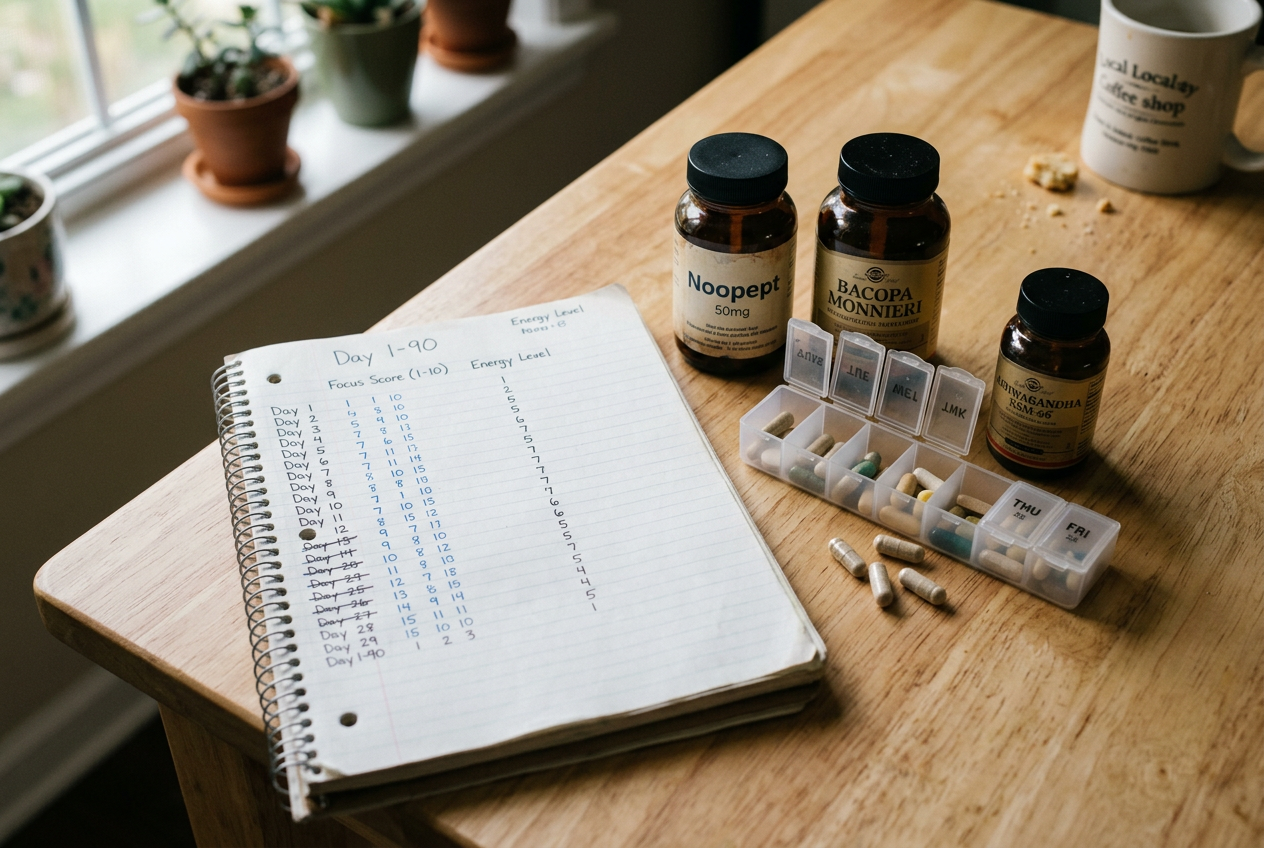
So I tracked words written per day, Pomodoro focus sessions completed (logged in a Notion table), and number of long-form articles finished per week. Not perfect metrics. But they’re tied to actual output, not how I felt about my output, which is a different thing entirely.
Days 1 through 30: 2 caps, 9am daily, always with food (more on why that matters later). Average written output: 1,200 words per day. No caffeine stacking for the first 60 days because I wanted to isolate the compound as cleanly as possible, which meant giving up my usual two cups of morning coffee and switching to decaf. That was its own kind of miserable for about a week. Pomodoro sessions averaged about 4.5 completed per day. Nothing remarkable. Roughly what I was hitting before I started.
Days 31 through 60: still 2 caps, same conditions. Average output climbed to 1,450 words per day. That’s a real increase. About 20%. I noticed it in the spreadsheet before I felt it, which is exactly the kind of lag that makes self-reporting unreliable. The Pomodoro count went up too, from 4.5 to about 5.8 per day. My guess is this is Bacopa starting to contribute, but I can’t prove that.
Days 61 through 90: I switched to 4 caps on writing days only, keeping 2 caps on days where I was mostly in meetings or running errands. Average output on writing days: 2,100 words. That’s a 75% increase over my starting baseline. Focus sessions on 4-cap days averaged 7.1 completed. On 2-cap days during this same period, I was at roughly 5.5.
The gap was real and consistent enough that I noticed it without looking at the numbers.
Total cost for the 90 days with mixed dosing came to approximately $155. I did one single bottle at 2 caps for the first two months, then a second bottle at varying doses through month three.
Here’s where I have to be honest about something that should bother you: I cannot cleanly separate the Phase 3 dose increase from the cumulative Bacopa effect that was also hitting its peak simultaneously. They overlapped. The output jump at day 61 could be the 4 caps. It could be 60 days of Bacopa finally firing. It could be both. Anyone who claims to have isolated these variables in a self-experiment is either lying or hasn’t thought carefully about their methodology. I haven’t, and I’m saying so now rather than in a footnote.
What I can say is that the numbers changed. The direction was consistent. And the change corresponded with a dose increase I made deliberately, not with any other meaningful lifestyle variable.
READ: Is Mind Lab Pro Worth the Money?
Where Mind Lab Pro Actually Goes Wrong in Practice
Nobody talks about the fasting problem. And they really should, because it was the first thing that hit me before any cognitive effect did.
Mind Lab Pro’s capsule shell contains prebiotic oat hull fiber. OptiNutra describes this as a delivery technology. What it actually does to some people who take it on an empty stomach is produce notable GI distress. Bloating, some cramping. Not severe. But unpleasant enough to notice. OptiNutra does recommend taking it with food, but that guidance is buried well below the headline on their site, and most reviewers who do the “morning fasted nootropic” routine never mention it because they either didn’t experience it or didn’t connect the two things.
“Take with food” should be the first sentence of every dosing guide for this product. The fact that it isn’t tells you something about what the company prioritizes. The “clean supplement” image is worth protecting. A prominent GI warning is less clean-looking. So it ends up in small text, and people keep taking it fasted and wondering why their stomach hurts at 8am.
Then there’s the SSRI issue. Rhodiola Rosea is in here at 50mg per 2-cap serving, 100mg at 4 caps. Rhodiola has mild MAO-inhibiting properties. Not a black box warning, not in the same category as a clinical MAOI. But theoretical interaction risk with SSRIs exists. This isn’t obscure pharmacology. It’s well-documented enough that any honest review aimed at adults who might be on antidepressants should mention it. And I have not found one mainstream Mind Lab Pro review that does.
That omission is negligent. The demographic buying nootropics for focus and mood skews toward exactly the population where antidepressant use is common. Young professionals, late-30s knowledge workers, people under chronic stress. The overlap is real. If you’re on an SSRI, talk to your prescriber specifically about Rhodiola Rosea 50mg daily before you start this. Not as a scare tactic. Just as basic due diligence that no one else is doing for you.
The cost math at 4 caps is genuinely uncomfortable. At $138/month with no bundle, you’re spending more than prescribed modafinil costs through telehealth in several US states, where prices typically run $75–99/month for a generic. That’s a real comparison. Modafinil is a scheduled substance with its own risk profile and not everyone wants to go that route, but the price equivalence is worth knowing.
And then there’s the supply chain problem, which is specific to international orders. OptiNutra ships from the UK. International delivery can take 10 to 21 days. If you run out and reorder late, you’re looking at a gap in dosing. A gap resets Bacopa’s accumulation timeline. The 2002 Roodenrys trial used continuous daily dosing, and the clinical effects they measured were cumulative. Interrupting that for two weeks isn’t just inconvenient, it potentially walks back weeks of progress on the slow-build ingredients.
Buy ahead. Set a calendar reminder to reorder at day 18 of a 30-day supply, not day 28.
READ: Maritime Pine Bark Extract (Pycnogenol) Review
READ: What to Stack With Mind Lab Pro (and What Not To)
Mind Lab Pro Pricing vs. the Actual Competition: What the Same Money Buys
Comparing nootropics by cost per bottle is almost completely useless. It’s like comparing a half-serving of one meal to a full serving of another and declaring the cheaper one a better deal. The serving size and the dose disclosure have to be part of the calculation, otherwise you’re just comparing packaging.
Mind Lab Pro single bottle: $69 for 60 capsules. That’s 30 days at 2 caps, or 15 days at 4 caps. Most people buy it thinking they’re getting a month’s supply. At the effective dose, they’re getting two weeks.
Alpha Brain from Onnit runs $79.95 for 90 capsules, which looks like a better deal until you open the label. Alpha Brain uses proprietary blends. They don’t disclose the Bacopa milligram amount. At all. You have no idea if it’s 30mg or 200mg. It could be anywhere in that blend. So when someone tells me Alpha Brain is cheaper per dose, I ask: cheaper per dose of what exactly? You can’t benchmark against clinical studies if you don’t know the dose.
Qualia Mind from Neurohacker is $139/month at their standard dosing of 7 capsules per day. Twenty-eight ingredients, which sounds impressive. But when I went through that ingredient list, five of them are vitamins — B6, B12, C, D3, folate — that you can buy in a basic multivitamin for roughly $0.10 per day. The actual nootropic stack inside Qualia Mind is narrower than the 28-ingredient headline implies. At 4 caps of Mind Lab Pro on the 3-bottle bundle, you’re at about $3.68/day. Qualia Mind’s per-day cost works out to about $4.63. For a comparable ingredient stack (minus the vitamins you’re probably already getting elsewhere), Mind Lab Pro is competitive. Almost exactly competitive, actually. The $4.60/day 4-cap MLP versus $4.63/day Qualia comparison surprised me when I did the math.
Essentially the same price for roughly equivalent cognitive coverage.
Thesis Nootropics runs $119/month and offers personalized formulas based on a quiz. I have opinions about that model. The personalization is real in the sense that you’re choosing between different pre-built blends, but it’s subscription-locked in a way I find irritating. If you want to modify your formula, you’re doing it through their system on their timeline. And the transparency on dosing is better than Alpha Brain but worse than Mind Lab Pro. Also: $119 before you even hit the effective dose range.
The perception that Mind Lab Pro is overpriced comes almost entirely from comparing its 2-cap dose against full-dose competitors. At 4 caps, it’s priced fairly. And it has something none of the above have in the same depth: published white paper documentation of the formula rationale, specific study citations for each ingredient, and dose transparency that lets you actually do this kind of comparison in the first place.
READ: L-Theanine Nootropic Review
READ: Do You Need to Cycle Mind Lab Pro?
Who Should Not Buy Mind Lab Pro (And What to Take Instead)
The “universal nootropic” positioning is Mind Lab Pro’s biggest credibility problem. And I mean that seriously, not as a marketing critique. When you design a product for everyone you design it for no one, but more practically, you let the wrong people spend money on something that won’t serve them well.
This is a product optimized for roughly 35–55-year-old knowledge workers with consistent daily routines and $140/month available for cognitive support. That’s a real demographic. There’s nothing wrong with that demographic. But it should say so, and it doesn’t.
Under-25 users. If you’re under 25, your endogenous NGF levels are near peak. Lion’s Mane’s primary proposed mechanism for cognition is NGF upregulation in aging or declining neural tissue. The Mori 2009 trial that everyone cites had a mean subject age of 51.2 years. That’s not a coincidence. The neurogenesis-supporting ingredients in this formula are considerably more relevant for a 40-year-old noticing cognitive slowing than for a 22-year-old in their cognitive prime. You might get some Citicoline benefit. But you’re paying for eleven ingredients and only a few of them are doing anything meaningful for your age group.
Anyone needing same-day cognitive lift. If you’re looking for something that helps you perform better at tomorrow morning’s presentation, Mind Lab Pro is not your product. No racetam. No stimulant. No caffeine. The only acute actors are Citicoline and L-Theanine, and you can replicate that combination specifically for about $0.40 per day. A $15 bottle of Cognizin-branded Citicoline plus a $12 bottle of pure L-Theanine gives you the exact acute portion of the Mind Lab Pro formula at roughly equivalent doses. If same-day effects are your goal, build that stack yourself and skip the other nine ingredients you’re not getting enough of anyway to matter.
SSRI users. Already covered this in the failure-points section but it bears repeating here plainly: Rhodiola Rosea 50mg daily has theoretical MAO-inhibiting properties that create interaction risk with serotonergic drugs. This is not a “definitely don’t do this” statement. It’s a “definitely talk to your prescriber first” statement. The risk is theoretical, not proven in clinical populations at this dose, but the conversation with your doctor costs you nothing and the risk of skipping it is non-trivial.
Students on a tight budget. At 2 caps, which is the dose you’ll actually use if you’re trying to make a $69 bottle last a month, the key ingredients are under-dosed. Bacopa at 150mg is half the RCT dose. Lion’s Mane at 500mg is well below what the studies used. You’re essentially paying $69 for a month of Citicoline and L-Theanine, with hopes for the rest.
A standalone Bacopa supplement with 300mg per dose runs about $15–20 per month. That specific ingredient, at the right dose, may produce better memory outcomes for less money than the full Mind Lab Pro formula at 2 caps.
I’m not trying to talk you out of the product entirely. I use it. But I use it at 4 caps, in a bundle, with a consistent sleep schedule and no major prescription interactions, at 39 years old, for a specific output goal I can track. That context matters. Without it, the product works less well, and at worst it’s just an expensive way to take Citicoline.
READ: L-Tyrosine Nootropic Review
READ: Can You Take Mind Lab Pro With Coffee?
The Honest Verdict After 90 Days: What Changed, What Didn’t, What I’d Do Differently
I won’t end this with “results may vary.” That phrase means nothing. It’s an abdication dressed up as a disclaimer. The reviewer’s entire job is to specify which variables determine those results. So let me try to actually do that.
My recommendation is conditional on dose and duration. At 2 caps, Mind Lab Pro is a well-sourced Citicoline and L-Theanine supplement with some under-dosed supporting ingredients that may or may not contribute at clinically meaningful levels. At 4 caps, it’s a legitimately well-assembled formula where the key ingredients, particularly Citicoline and Bacopa, hit or approach doses used in positive RCTs. These are not the same product for practical purposes.
If you’re going to do this properly, the math looks like this: a 3-bottle bundle at $207 gives you 45 days of supply at 4 caps. To run a full 90-day 4-cap trial, you need two bundles. That’s $414. I know how that number sounds. It’s real. If you’re not prepared to spend $414 over 90 days on a cognitive experiment, Mind Lab Pro at the effective dose is not your product. There are cheaper ways to get the acute Citicoline and L-Theanine effects, and the slow-build ingredients require the full 90-day window to evaluate properly.
For memory and learning specifically, I want to raise something slightly uncomfortable. A standalone Bacopa Monnieri supplement dosed at 300mg per day costs about $15–20 per month. That single ingredient, at the dose the research actually used, may outperform Mind Lab Pro’s 150mg inclusion for memory consolidation outcomes. If memory is your primary goal, it’s worth asking whether you need the full formula or whether a targeted Bacopa supplement plus a Citicoline/L-Theanine combo hits your actual goals more directly for a fraction of the cost.
What actually changed over my 90 days: written output went from 1,200 to 2,100 words per day between Phase 1 and Phase 3. That’s the headline number. I can’t attribute it cleanly to any single ingredient or even cleanly to the dose increase versus cumulative effects. But the number changed, the direction was consistent, and I didn’t change anything else meaningful during that period. I’ll take it.
What didn’t change: my ability to generate ideas, my mood, my social energy. I wasn’t looking for those things, to be fair. But I didn’t notice them shifting either. Mind Lab Pro isn’t an antidepressant and it’s not a creativity drug. It seems to affect the execution layer more than the inspiration layer, if that maps onto anything recognizable from your own experience.
What I’d do differently: start at 4 caps from day one. Buy two bundles at the start so there’s no supply gap risk. Take it with food, always, without exception. And set a hard calendar reminder to evaluate at day 90 using an actual output metric, not a vibe.
Reorder only if you can maintain daily dosing without supply gaps longer than five days. If your life is irregular, if you travel constantly and forget supplements, if your budget makes consistent 4-cap dosing feel stressful rather than sustainable, this is genuinely not the product for you right now. The continuous-dosing requirement isn’t a lifestyle suggestion. For Bacopa it’s pharmacologically necessary. And a supplement you can’t maintain consistently is a supplement that can’t work.
Mind Lab Pro deserves its reputation. It’s the most transparently documented ready-made formula I’ve found in this category, and the ingredient sourcing is legitimately better than most of what you’ll find at a comparable price point. But it’s being systematically under-used by its own customers, at the wrong dose, on a timeline too short to matter, by people who were never told about the three-phase window or the 4-cap option buried in a white paper most people don’t read.
That’s not a product failure. It’s a communication failure that costs customers money and the product its fair evaluation. You now have enough to make that evaluation yourself.