Two Separate Experiments That Got Merged Into One Claim
The trial that made creatine sound like a smart drug kept people awake all night and fed them 20 grams at once — a detail almost every headline quietly omits.
I spent probably forty minutes last year reading five different “creatine for your brain” roundups, and every single one did the same thing: cited the dramatic findings, left out the experimental conditions, and left me thinking my 5g morning scoop was doing something it almost certainly wasn’t. That’s not fabrication exactly. It’s more like describing a car crash test as proof the airbag works great on your commute.
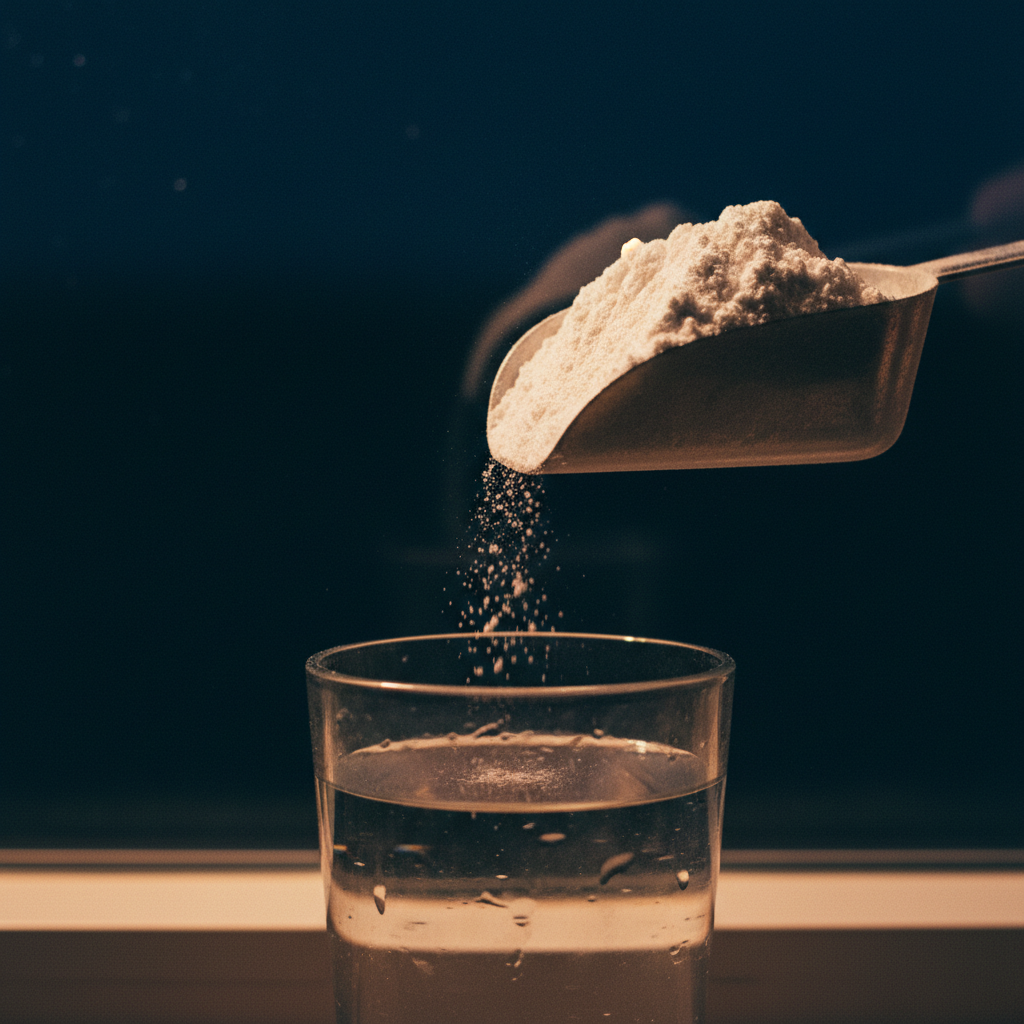
There are actually two distinct bodies of evidence here and they don’t answer the same question. The first is the acute sleep-deprivation protocol — one large dose, usually around 0.2 to 0.35 grams per kilogram of bodyweight, given to people who’ve been kept awake overnight. For a 165-pound adult that works out to roughly 15 to 26 grams at once. The second is the chronic daily supplementation research: 5 grams a day, consistently, over weeks, where researchers are asking whether slow tissue saturation produces cognitive benefits over time.
These are different experiments testing different mechanisms. Merging their results into one verdict is the core mistake. Not malicious. Just lazy, and it shapes what people actually do with their money.
READ: My top 3 best nootropic supplements, with every dose checked
Inside the Sleep-Deprivation Trials: Timing, Peak, and Fade
Here’s the detail I think should lead every single write-up on this topic: the benefit in those trials didn’t show up for about 3.5 hours after dosing. Peak effect was near 4 hours. Duration stretched up to 9 hours before fading.
That timeline is the finding. It tells you something really important about what creatine is and isn’t.
It’s not a stimulant. It doesn’t cross into your neurons and flip a switch. What it’s doing — at that 0.3 g/kg approximate dose used in the best-powered trials — is temporarily raising phosphocreatine availability in brain tissue that’s been drained by extended wakefulness. The brain burns through ATP fast under sleep deprivation, and creatine is a substrate for rebuilding it. But getting that substrate across the blood-brain barrier and into the right tissues takes time. A lot of time, actually.
Which means if you read one of those breathless articles, bought a tub, and took 20 grams the morning before a big presentation expecting the trial result, you didn’t get it. Not because the research is wrong, but because the timing was off by hours. The 4-hour onset is arguably the most useful finding in this whole literature and it almost never gets mentioned. Take it too late and you’re still waiting for it to kick in when the challenge is already over.
I find this genuinely fascinating, honestly. That a compound can have a real cognitive effect with that kind of kinetic profile is interesting. It’s just not interesting in the way nootropic marketing wants it to be.
Daily Dosing: What the Meta-Analyses Actually Showed
The chronic evidence is real. I want to be clear about that before I explain why it’s also smaller than most people assume.
Meta-analyses of daily creatine supplementation — typically in the 5 to 10 grams per day range for cognitive studies, notably higher than the 3 to 5 grams per day most gym-focused guides recommend — found improvements in memory and processing speed. Those are real findings. But composite scores for overall cognition? Executive function measures? Mostly null. The effects that replicated are specific and modest.
Older adults show up most consistently as the group that benefits. That makes mechanistic sense. Aging brains run lower baseline creatine levels, so there’s more headroom for supplementation to actually move something. In younger, well-rested adults with normal creatine status, the chronic evidence gets thinner and less consistent fast.
I changed my mind about this about eight months into tracking my own stack. Five grams a day, mid-thirties, decent sleep, not particularly stressed. Kept careful notes for six weeks — same coffee throughout, same sleep schedule, one variable at a time, the way I always try to do it.
I couldn’t point to a single thing I’d attribute to it. That doesn’t mean nothing was happening, but the meta-analysis null result on executive function in healthy younger adults felt pretty accurate to my own experience. That’s the honest version of the chronic evidence. It’s credible precisely because it doesn’t oversell.
- Hour 0Dose taken~0.3 g/kg bodyweight — roughly 15 to 26 g for a 165-lb adult
- ~Hour 3.5Benefit beginsPhosphocreatine availability in brain tissue starts to rise; no effect before this point
- ~Hour 4Peak effectCognitive protection against sleep-deprivation impairment is at its strongest
- Up to Hour 9Effect fadesDuration stretches roughly 9 hours before declining
Brain Saturation Is Slower — and That Explains the Dosing Gap
This is probably the most underreported fact in the whole conversation. Skeletal muscle and brain tissue don’t express creatine transporters the same way. Muscle has high transporter density and saturates fairly quickly on a standard loading protocol. Brain tissue has lower transporter expression, and uptake is slower. The ceiling is lower too.
That’s why cognitive researchers studying daily supplementation consistently use 5 to 10 grams per day rather than the 3 to 5 gram standard you see in sports nutrition. They’re not just rounding up. They’re working with a tissue that absorbs creatine more slowly and needs a longer runway to reach meaningful saturation.
What this means in practice: if you’ve been taking 3 grams a day because some fitness app said that’s maintenance, you may have your muscles well-stocked and your brain running behind. Not dramatically behind, probably. But the idea that one dose fits both goals is lazy guidance, and the transporter biology makes that clear. If cognitive outcomes are what you’re after, the dosing strategy is different. The loading period is longer too. Expect weeks, not days, before any chronic effect has a chance to show up.
I wish someone had spelled this out for me early on. I spent about three months at an underdose — 3 grams, because that’s what the label said for “maintenance” — wrote creatine off for cognitive use, and only found the actual study doses buried in a methods section much later. That was an annoying three months.

READ: Is creatine a nootropic?
Affordability and the Studied Dose Actually Align Here
I’ve written a lot on this site about the gap between the dose that got studied and the dose that ends up in your capsule. It’s my biggest frustration with this whole category. You buy a lion’s mane product because a trial found benefits at 2,000 to 3,000 milligrams per day, and then the label says 500 milligrams per serving. A fifth of the studied amount. And half the time it’s buried in a proprietary blend so you can’t even confirm what you’re actually getting. Every time. It drives me insane.
Creatine monohydrate is the exception.
Bulk creatine runs about five to ten cents per gram at commodity pricing. I’ve been buying a kilogram bag from the same supplier for a while and the math works out to roughly that. A 20-gram acute dose costs you somewhere between one and two dollars. The chronic 5 to 10 grams per day works out to fifty cents on a good day. These are the actual studied doses. You can afford them at full dose. That’s genuinely unusual in this space.
Compare that to almost anything else in the nootropic category and the contrast is sharp. With creatine, the financial barrier to matching the research protocol is basically nonexistent. Worth saying plainly because it changes the calculus entirely.
Dose used in the researchDose in the product
Stacking Creatine With a Formulated Nootropic: Overlap and Gaps
A question I get pretty often in the comments is whether creatine is already covered if you’re taking a comprehensive formulated stack. The short answer is no, and the reason is specific.
Mind Lab Pro v4.0 contains zero creatine. The two-capsule serving gives you citicoline at 250 milligrams, lion’s mane at 500 milligrams, phosphatidylserine at 100 milligrams, and several other actives. Worth noting the lion’s mane serving is below the 2,000 to 3,000 mg range used in the trials that generated the most interesting findings — but that’s a separate conversation, and I’ve covered it elsewhere.
The point here is that creatine and citicoline work through completely different pathways. Citicoline is an acetylcholine precursor, supporting neurotransmitter synthesis. Creatine is an energy substrate, supporting ATP regeneration under metabolic stress. Different bottlenecks entirely. One doesn’t substitute for the other, they don’t compete, and combining them is one of the cleaner mechanistic rationales I can point to in the whole “what goes well together” question.
That’s not common. Most combination rationales are speculative at best.
So if you’re already taking MLP and wondering whether to add creatine on top, they don’t overlap. What you’re adding is the substrate side of brain energy metabolism, which the formulation doesn’t address at all.
Practical Decision: Which Protocol Fits Your Situation
I want to be direct here because I’ve hedged this kind of thing into uselessness before and it doesn’t help anyone.
If you have a specific upcoming event involving sleep deprivation — a red-eye, an overnight deadline, a long shift, something where you already know you won’t sleep — the acute protocol has the strongest evidence behind it. Take approximately 0.3 grams per kilogram of your bodyweight, timed about 3.5 hours before the period of impairment starts. Not 30 minutes before. Not the morning of. Plan it out. That’s the protocol that generated the results people keep quoting, and the timing is non-negotiable given the onset window.
If you’re over 50 and interested in gradual cognitive support, the chronic daily evidence is genuinely worth considering. Start at 5 grams per day — the low end of the 5 to 10 gram range studied for cognitive outcomes — and be patient. Weeks, not days.
Expect something modest and specific, probably around memory and processing speed. Not a wholesale change in how you think.
If you’re a healthy, well-rested person in your twenties or thirties hoping creatine will sharpen a normal Tuesday, the current evidence doesn’t support that. I know that’s not what you wanted to hear. The populations most consistently supported by the data are older adults and sleep-deprived people. Extrapolating from those trials to a general cognitive enhancer for all adults is the same conflation error this whole post has been about. You might still choose to take it for other reasons — muscle, recovery, the chronic dosing is cheap — but walk in with accurate expectations.
And neither protocol is a workaround for sleep. That part I say from experience. Sleep deprivation with 20 grams of creatine is still worse than being rested. It just might be slightly less bad than sleep deprivation with nothing.
READ: Creatine: what it is
Conclusion
Creatine has real cognitive evidence behind it, but the evidence is narrow and the conditions matter a lot. The acute protocol works under sleep deprivation, at a specific dose, with a 3.5-hour lead time — not as a general focus booster. The chronic protocol has modest support for memory and processing speed, mostly in older adults, at doses higher than most labels suggest. If you’re taking it at 3 grams because that’s what the bag says, you’re probably underdosed for brain outcomes. If you’re taking it expecting the sleep-deprivation trial result on a well-rested morning, you’re applying the wrong study entirely.
Questions, pushback, or your own experience with the timing — drop it in the comments. That’s what they’re there for.
READ: My top 3 best nootropic supplements, with every dose checked