
Lion’s mane is the mushroom that’s been studied for memory and thinking. Cordyceps is the one that’s been studied for exercise. That’s the real split between them, and it’s why a student and a cyclist shouldn’t buy the same jar. But I’ll be straight with you, folks: neither one has strong evidence in healthy young people. The best lion’s mane results come from older adults with memory problems, and the one cordyceps trial in trained cyclists found nothing at all.
That’s the short answer.
I’ve kept notes on this stuff since 2021, when I added up a year of supplement spending and couldn’t point to one thing it had done for me. Mushrooms are the newest craze in my inbox. Every week somebody asks which one to pick, usually right after a coffee brand sold them a “focus” blend with both in it. So I read every human trial I could find on each, wrote them into my notes, and ran both myself, one at a time, for four weeks each. I bought it myself, both of them.
Quick and important: I’m not a doctor, and this isn’t medical advice. If you take any medication, you’re pregnant or nursing, or you have a health condition, talk to your doctor or pharmacist before you try either mushroom. I’m also leaving amounts out of this one on purpose. Products vary too much from label to label, and how much to take is a talk for your doctor, not a blog.
Here’s what I’ll cover:
- what lion’s mane actually is, and where it grows
- why most “cordyceps” in a capsule never touched a caterpillar
- what the lion’s mane trials measured, one by one
- what the cordyceps trials measured, including the one that found nothing
- the line on the label that tells you which part of the mushroom you’re paying for
- which one I’d try first as a student, and which as an athlete
- who should talk to a doctor before taking either
- what four weeks of each did for me
Lion’s Mane Is the Shaggy One on the Tree
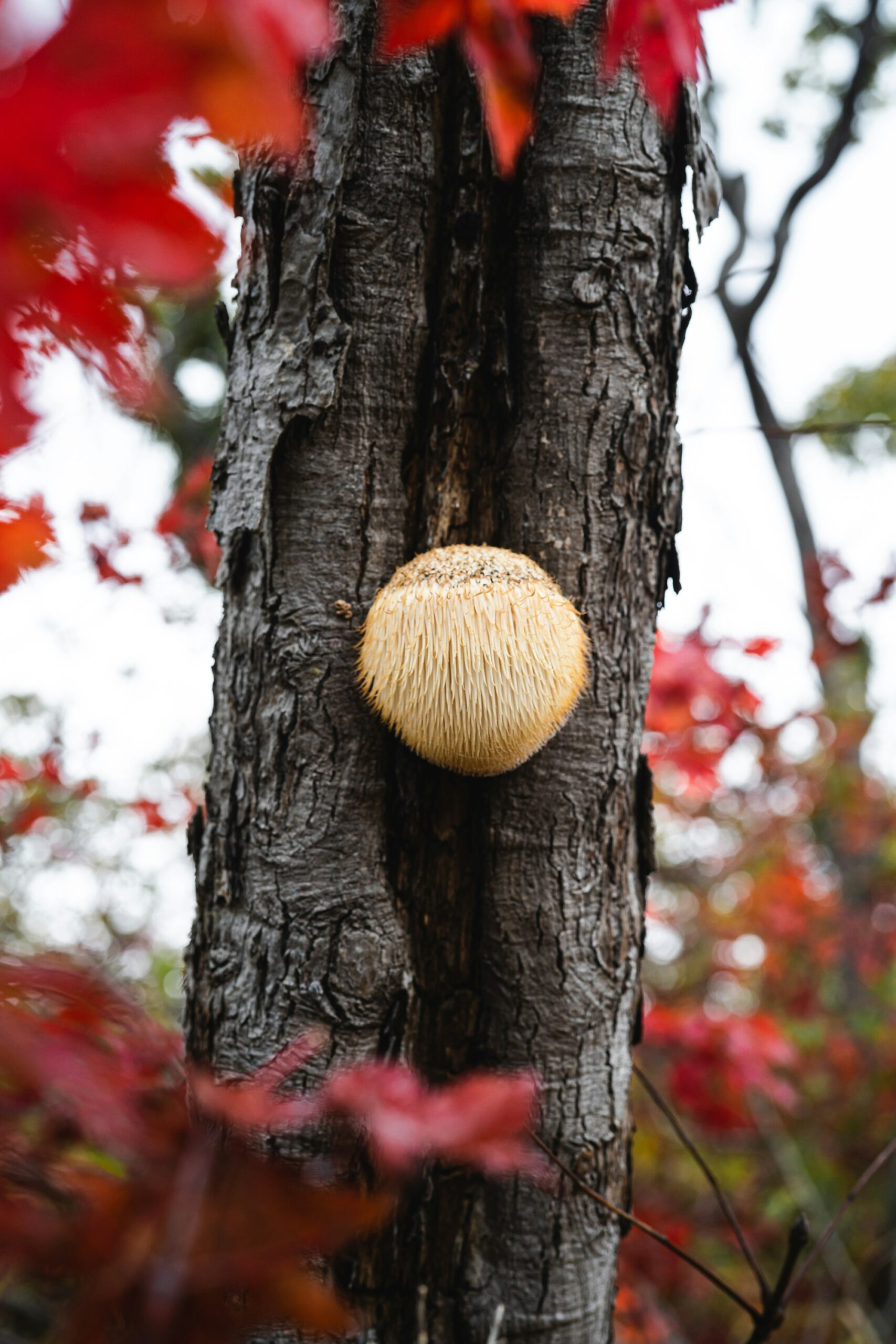
Lion’s mane (Hericium erinaceus) looks like nothing else in the woods. It grows as a single clump of soft spines, white to cream, kind of like a pom-pom or a frozen waterfall, and it usually sits on a hardwood tree. That’s one in the photo at the top of the page, a round one on a trunk in the fall, red leaves all around it. In North America and Europe it shows up from late summer into autumn, and it’s fond of beech and maple.
A clump can be anywhere from about 5 to 40 centimeters across. The spines run 1 to 5 centimeters long.
In Japan it’s called yamabushitake, and the Chinese name means “monkey head mushroom.” People cook it like any other mushroom, and it’s generally considered safe to eat as food. Whether it’s safe or useful as a supplement is a separate question, and that one hasn’t been settled.
The supplement buzz comes from two families of compounds found in it. They’re called hericenones and erinacines. In lab work they’ve been tied to nerve growth factor, and that’s where every “brain mushroom” ad starts. But a lab dish isn’t a person. What counts is what happened when real people took it, and that list turns out to be short.
READ: Lion’s Mane: What the Newest Trials Actually Found
Most “Cordyceps” Never Saw a Caterpillar
Cordyceps is messier, and this is the part almost every comparison skips.
The famous one, the one in traditional Chinese and Tibetan medicine, is the caterpillar fungus. Scientists renamed it Ophiocordyceps sinensis in 2007, but plenty of labels still say Cordyceps sinensis. It infects ghost moth larvae in the ground on the Tibetan Plateau and in the Himalayas, 3,000 to 5,000 meters up, kills them, and pushes a thin stalk out through the soil. It’s picked by hand. It’s pricey enough that owning it is a status symbol, and it’s now listed as endangered in China. Wild-picked ones can also carry a lot of arsenic and other heavy metals, and China has regulated their sale since 2016.
So that’s not what’s in the bottle at the drugstore. Honestly, at that price it couldn’t be.
What you’ll usually get is one of two other things. The first is mycelium (the root-like threads of the fungus) grown in a lab or a fermentation tank. The cordyceps trials below used a product called Cs-4, sold as CordyMax, which the papers label Cordyceps sinensis. The second is a different species altogether, Cordyceps militaris: a small orange club of a mushroom, 1 to 8 centimeters tall, farmed on rice, on silkworm pupae or in liquid. It’s easy to grow, and it makes a compound called cordycepin.
I went looking for a real photo of each one and none I could verify made the cut, so the graphic has to carry this section. Here’s the takeaway, though. If your label just says “cordyceps,” with no species and no part named, you don’t actually know which of these you bought.
What the Lion’s Mane Trials Actually Measured

Here’s every human trial I could read the results of. Pay attention to who was in each one. The strongest result came from people a lot closer in age to the man in that photo than to a college student, and that’s where the marketing gets slippery.
The one everybody cites came out of Japan in 2009. In it, 30 men and women aged 50 to 80, all diagnosed with mild cognitive impairment, were split into two groups of 15. One group took lion’s mane tablets and the other a placebo, for 16 weeks. The lion’s mane group scored higher on a cognitive scale by week 8, and it stayed ahead at the checks in week 12 and week 16. Then, 4 weeks after they stopped, their scores dropped again. It’s a real result. It’s also 15 people on lion’s mane, and the lab that ran it belongs to a mushroom company.
A second Japanese trial, from 2019, ran 12 weeks on a fruiting-body supplement and used three different memory and thinking tests. Only one of the three, a short screening test called the MMSE, improved.
A tiny 2010 study gave 30 women lion’s mane cookies or plain ones for 4 weeks. The lion’s mane group’s depression scores and a checklist of vague everyday complaints went down from where they started. Interesting! But it’s mood, not focus.
Now the two that matter for a student. In 2023, researchers gave 41 healthy adults aged 18 to 45 lion’s mane or a placebo. An hour after a single dose, the lion’s mane group was quicker on one task, the Stroop test. After 28 days there was a trend toward less stress that just missed statistical significance, and the authors said plainly that they also saw null and some negative results.
Then a 2025 crossover study of 18 healthy adults aged 18 to 35 found no overall effect after one dose. One test of hand speed, a pegboard, improved. Some of its authors work for a company that puts lion’s mane in its products.
See the pattern? The bigger effects turn up in older people with a diagnosis. In healthy young people you get one faster task here and one better pegboard there. That’s not nothing. It’s also not the “laser focus” printed on the bag.
The Cordyceps Trials, Including the One That Found Nothing

Cordyceps has mostly been tested on exercise, usually with people pedaling a stationary bike like that one while the researchers measure their breathing.
The most hopeful trial, from 2010, gave 20 healthy adults aged 50 to 75 Cs-4 or a placebo for 12 weeks. Two markers of how hard they could pedal before tiring went up: the metabolic threshold by 10.5% and the ventilatory threshold by 8.5%. VO2 max, the big yardstick of aerobic fitness, didn’t change. The authors called it a pilot study, and that’s what it is.

Now flip to people who actually race, like the riders in that shot. In 2004, 22 endurance-trained male cyclists took Cs-4 or a placebo for 5 weeks. Nothing changed. Not VO2 peak, not their time trial. The placebo group finished the time trial in 61.4 minutes on average and the cordyceps group in 62.1. The paper’s title says it outright: Cs-4 “does not improve endurance exercise performance.”
A 2005 study of 8 people on a cordyceps and rhodiola formula found no difference on any measure either. And a 2017 study of 28 young adults on a mushroom blend containing Cordyceps militaris saw VO2 max go up after 3 weeks, though not after 1. That’s encouraging. It was a blend, though, so you can’t pin it on the cordyceps alone.
Memorial Sloan Kettering’s herb database sums up the exercise research in two words: mixed results. My notes say about the same.
READ: Third-Party Tested Nootropics: What Those Seals Actually Mean
Fruiting Body or Mycelium? Read This Line on the Label
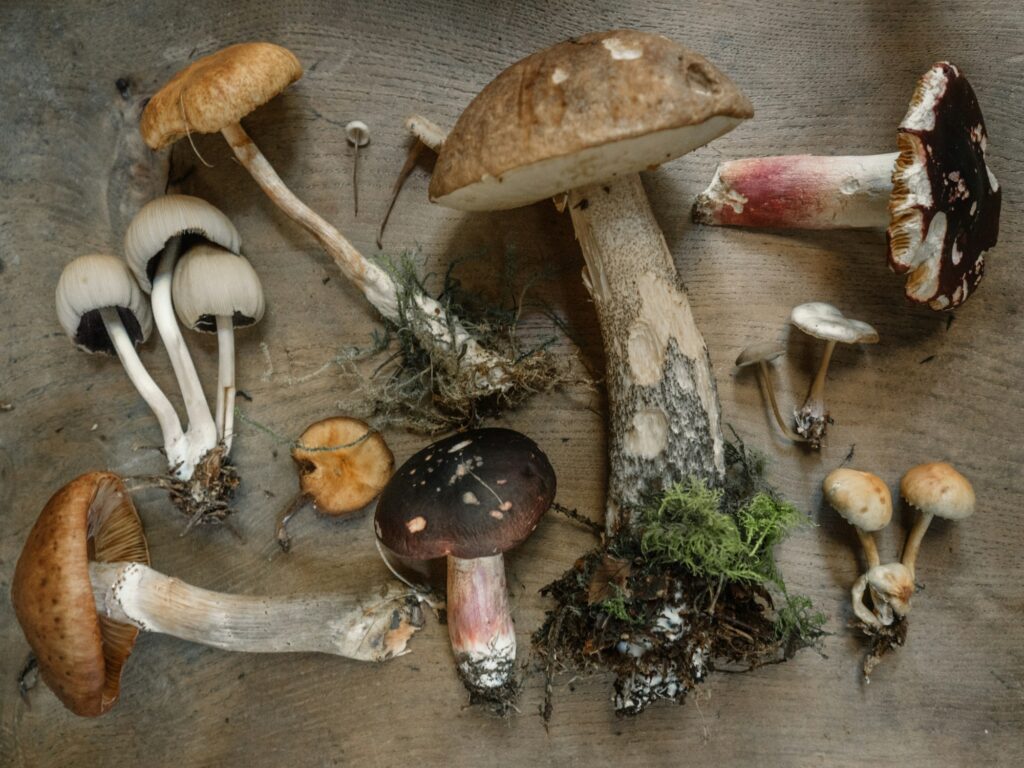
Every mushroom has two parts, and a good label names the one you’re buying. The caps and stems in that photo are fruiting bodies, the part you’d cook. The mycelium is the network of fine threads that grows underground or inside wood. You can see bits of it, tangled up with soil and moss, at the base of a few of those stems.
Either part can be sold as “lion’s mane” or “cordyceps.” So look for one of these lines on the label:
- “Fruiting body” or “mushroom”: the actual mushroom itself. It gets dried and ground, or extracted.
- “Mycelium”: the threads, usually grown in a lab.
- “Mycelium on brown rice” or “myceliated oats”: mycelium grown on grain, then ground up together with that grain.
That last one deserves a second look. Once mycelium grows through grain you can’t pull the two apart, so part of every scoop is the grain. A 2025 lab comparison of chaga products (a different mushroom) found the grain-grown ones were rich in starch. Fair warning, its authors work for a company that sells fruiting-body extracts, so they have skin in the game. Still, a label that names the part tells you what you’ve got. A proprietary blend that hides it tells you something too.
For lion’s mane, most of the trials I read used the fruiting body. For cordyceps, it was mostly Cs-4 mycelium or a blend with militaris in it. Match the label to the research, or you’re testing something nobody tested.
READ: Proprietary Blends: Why You Can’t Tell What’s In the Bottle
A Student or an Athlete: Which One I’d Try First

If you’re studying, lion’s mane is the closer fit on paper. Its trials measured thinking, and in healthy adults the one clear result was speed on a single task. Keep your hopes small, though. Like the guy in that photo, you’re still the one who has to do the reading.

If you ride, run or train for endurance, cordyceps is the one that’s been tested for it. Just be honest about who got results. It was healthy adults aged 50 to 75, not athletes. The trained cyclists got nothing, and if you’re out on a road at sunset like this rider, you probably have more in common with them.
And if you want something that reliably moves the needle? Honestly? I’d put my effort into sleep and a sensible training plan first. I know that sounds dull. Turns out dull is what my notes keep landing on.
Who Should Talk to a Doctor Before Either One

Both mushrooms were generally tolerated in the trials I read. The 2009 lion’s mane trial reported no adverse effects in its lab tests, and Memorial Sloan Kettering lists no major side effects for cordyceps. That doesn’t make either one right for everybody.
Memorial Sloan Kettering tells people to talk with their healthcare providers before taking cordyceps, because herbal supplements are stronger than the herbs you’d cook with and can interact with some medications. I’d say the same about lion’s mane. So please check with your doctor or pharmacist first if any of these fit you:
- you take any prescription medication
- you’re pregnant or breastfeeding
- you have a medical condition, or surgery coming up
- mushrooms have ever disagreed with you
- you’re buying it for a child or a teenager
And if you’re looking at either one because your memory has gotten worse lately, that’s a doctor visit, not a supplement order. Memory changes have a lot of causes, and some of them are very treatable.
My Four Weeks With Each, and Where I Landed
I ran lion’s mane first: a fruiting-body powder, stirred into my morning coffee every day for four weeks. Same sleep, same coffee, same work. My notes say I felt about the same, and the one honest thing I can report is that I stopped expecting anything somewhere around day ten.
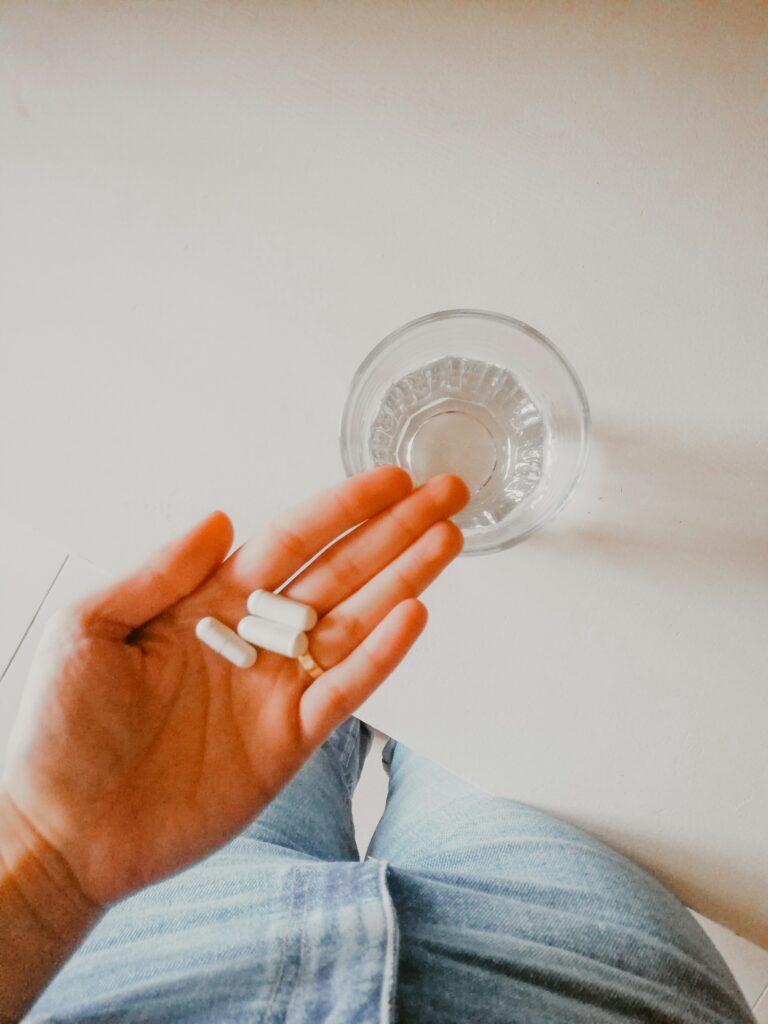
Then two weeks off, then four weeks of a Cordyceps militaris capsule product every morning while I kept riding my usual Saturday loop. My mornings looked a lot like that photo, a glass of water and the capsules, minus the nice jeans. My times didn’t budge. For me, it did nothing.
That’s one guy, not a study, and you might land somewhere else. But it lines up with what the research says about people like me: healthy, under 50, already active.
So here’s where I come down. If you’re curious about lion’s mane for studying, it has the better story for thinking, and the small studies are honest about how small the effects are. If you want cordyceps for endurance, remember the trained cyclists saw no change, and buy one that names its species and its part. And if it’s a blend of both hiding inside a proprietary blend, you’ll never know which one did what, if either did anything.
Got a mushroom product you want me to read the label on? Drop it in the comments, I read every one. That would be it folks!