The FTC Sued Prevagen’s Manufacturer — and Almost Nobody Covering This Comparison Mentions It
January 2017. The Federal Trade Commission filed a complaint against Quincy Bioscience for deceptive advertising. That fact doesn’t appear in any of the first ten Google results comparing these two supplements. I checked. And if you’re spending $40 to $60 a month on something your doctor didn’t recommend, it should probably be the first thing you read — not buried in paragraph nine of a review that calls both products “promising.”
A cheap bottle you take three of is not cheap — the free cost per serving calculator works out the cost of your actual daily amount.
I’m not a doctor. I say that early because I mean it. But I spent over $1,100 on supplements in a single year and couldn’t name one that did anything, and that experience made me obsessive about reading the actual evidence before I buy. Prevagen vs CoQ10 looks like a fair fight until you look closer. One of these has 40 years of biochemistry behind it. The other is a jellyfish protein in a capsule.
These are not the same kind of supplement. That’s the whole story.
What You Are Actually Buying: One Ingredient vs One Enzyme
Prevagen’s active ingredient is apoaequorin. One protein, from jellyfish, at 10mg per capsule in the Regular and 20mg in Extra Strength. The marketing says it’s a memory supplement. The proposed mechanism is that apoaequorin binds excess calcium in brain cells and reduces neurotoxicity. Sounds plausible until you ask how a protein you swallowed gets into your brain intact. We’ll get there.
CoQ10 is a different thing entirely. It’s not a foreign compound. Your body makes it. Every human cell contains CoQ10, with the highest concentrations in the heart and liver at around 100 to 200 micrograms per gram of tissue. Young adults synthesize roughly 500mg internally per day. It works as a cofactor in the mitochondrial electron transport chain — the machinery that actually produces cellular energy. It has a job. A specific, documented, biochemical job.
Most comparisons online throw both of these into a “nootropic” category and call it a day. That framing is wrong. CoQ10 is a mitochondrial cofactor with a metabolic function researchers have studied since the 1950s. Apoaequorin is a calcium-binding protein from a bioluminescent jellyfish with no established metabolic role in humans. The leap from “binds calcium in a petri dish” to “improves human memory” was never convincingly bridged.
The Absorption Problem Prevagen’s Marketing Ignores
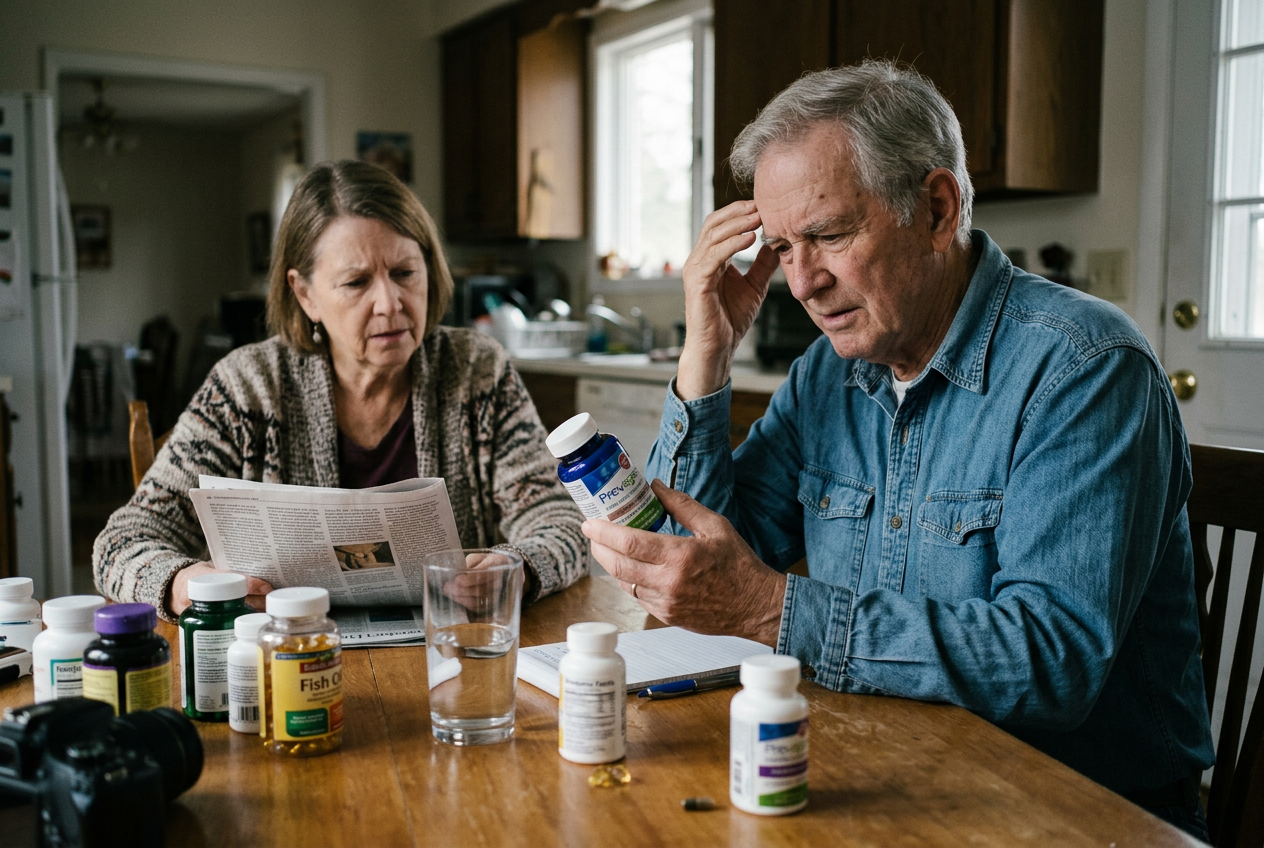
Apoaequorin is a protein. When you swallow a protein, your stomach goes to work on it. Stomach pH runs between 1.5 and 3.5, and proteases start breaking down dietary proteins within about 60 minutes. By the time anything from that capsule clears your gut, apoaequorin as a functional protein is gone. It’s amino acids. Your body absorbed amino acids — not a memory-enhancing jellyfish compound.
And even if some fragment survived digestion and reached circulation, there’s the blood-brain barrier. It blocks proteins larger than roughly 500 daltons. Apoaequorin is about 21,000 daltons.
The math is not subtle.
Quincy Bioscience points to their Madison Memory Study — 218 participants — and you’ll see it cited constantly as proof that Prevagen works. What those reviews don’t mention: the study was never published in a peer-reviewed journal. The manufacturer ran it themselves. The FTC filed their January 2017 complaint against Quincy Bioscience partly on the grounds that this study did not provide reliable scientific evidence of the product’s benefits.
An unpublished, manufacturer-funded study of 218 people is not clinical evidence. It’s marketing material. Citing it as proof is like citing a car company’s own brochure as an independent safety review. Review sites keep treating this as a legitimate data point, and I find that genuinely frustrating.
CoQ10’s Actual Mechanism and Who Genuinely Needs It
CoQ10 sits at Complex I and Complex III of the mitochondrial electron transport chain, shuttling electrons and helping generate ATP. No ATP, no cellular function. That’s the mechanism. Not theoretical.
The people with documented, measurable CoQ10 deficiency are specific. Statin users: a 2014 meta-analysis by Skarlovnik and colleagues found statins reduce plasma CoQ10 levels by 16 to 54% depending on dose and the specific statin. Adults over 50: CoQ10 levels in the brain drop roughly 50% between age 20 and 80. People with mitochondrial disorders. That’s not a vague list — those are people with a real biochemical reason to supplement.
Standard supplemental doses run 100 to 300mg per day for ubiquinone and 100 to 200mg per day for ubiquinol. One thing that consistently surprises people: absorption increases roughly threefold when you take it with a high-fat meal versus fasting. I take mine with breakfast — eggs, avocado, the whole thing. That single change probably doubled what I was actually absorbing during the first year I was taking it.
A lot of articles treat CoQ10 as purely a heart supplement and wave off its brain relevance. That’s wrong. Neurons have among the highest mitochondrial density of any cell type in the body. Brain tissue is extraordinarily energy-hungry. A compound that directly supports mitochondrial ATP production is not cognitively irrelevant. If you’re over 50 or on a statin and you’re buying Prevagen instead of CoQ10, that’s a genuinely bad trade.
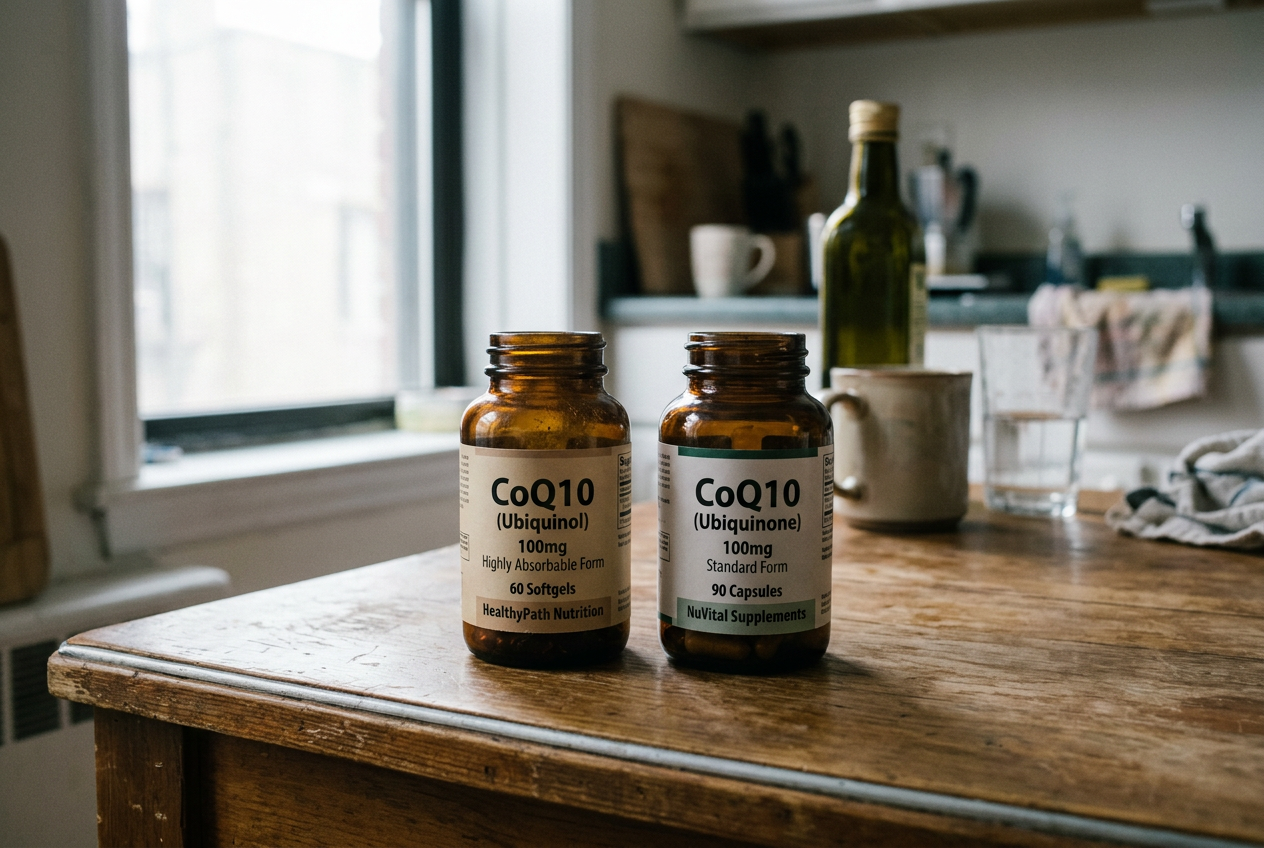
Ubiquinol vs Ubiquinone: The Form Matters More Than the Brand
Nobody writing Prevagen vs CoQ10 articles talks about this. They should, because it changes the cost-benefit math significantly.
CoQ10 exists in two forms. Ubiquinone is the oxidized form — cheaper, more common on shelves. Ubiquinol is the reduced form, the version your cells actually use. Your body converts ubiquinone to ubiquinol internally. Under 40, that conversion is efficient. Over 50, it’s not. A 2007 study by Hosoe and colleagues found ubiquinol shows 3 to 4 times higher plasma absorption than standard ubiquinone in adults over 50. That number matters.
Ubiquinol costs more. You’re looking at roughly $0.60 to $1.20 per day at 200mg, versus $0.15 to $0.40 per day for ubiquinone at a comparable dose. But if you’re over 50 and buying cheap ubiquinone because the label says “CoQ10,” you may be absorbing a fraction of what you paid for. Honestly, buying cheap ubiquinone at that age is nearly as wasteful as buying Prevagen. Not quite. But close.
Look for “Kaneka QH” on the label. Kaneka is the manufacturer that’s done the most substantial human bioavailability research on ubiquinol. It’s not a guarantee of product quality across the board, but it at least tells you the active ingredient has been studied in actual people — not a proprietary trial the company ran and never submitted anywhere. Generic “CoQ10 100mg” recommendations that don’t specify form are almost useless as guidance.
Price Per Month, Broken Down Honestly
Prevagen Regular, 30 capsules at 10mg, retails at $39.95 at Walgreens and around $34.99 on Amazon. Extra Strength, 30 capsules at 20mg, runs $59.95 MSRP. So per month, you’re spending $35 to $60 for one ingredient that can’t survive your stomach acid.
Doctor’s Best CoQ10 — ubiquinone, 360 softgels — at 200mg per day works out to roughly $0.22 per day. About $6.60 per month. Jarrow QH-Absorb, a ubiquinol option with the Kaneka QH form, runs closer to $0.90 per day, roughly $27 per month at 200mg.
Prevagen costs 4 to 6 times more per month than a quality ubiquinol CoQ10 at a dose the studies actually used. That premium is not pharmacological. It’s a marketing budget — the TV ads, the pharmacy endcap placement, the branding aimed at older adults worried about their memory. You’re funding that.

Side Effects That Actually Show Up in Practice
CoQ10’s side effect profile is genuinely mild. GI upset at doses above 300mg per day is the main thing that shows up consistently. One interaction worth knowing: CoQ10 may reduce warfarin efficacy at doses above 100mg per day. If you’re on a blood thinner, that’s a real conversation to have with your doctor before you start.
Prevagen’s side effect picture is different. The FDA’s CFSAN Adverse Event Reporting System database contains over 1,000 adverse event reports for Prevagen as of 2023. Those reports include seizures, strokes, tremors, and falls. Prevagen Extra Strength shows a higher adverse event rate per unit sold than the Regular, based on the CAERS data patterns. The label includes a warning that the product isn’t suitable for people with a known shellfish allergy, citing cross-reactivity concerns — jellyfish isn’t shellfish, but they include it anyway, which is its own interesting signal about how confident they are in the product’s safety profile.
Most reviews describe Prevagen as “generally safe.” I don’t think that framing holds up when you look at the CAERS data, especially for older adults already at elevated risk for falls and seizures. A supplement with 1,000-plus adverse event reports and zero peer-reviewed efficacy data should not be the first thing someone reaches for when they’re worried about their memory. Those people deserve an actual clinical evaluation.
When Neither of These Is the Right Answer
Most people reading a Prevagen vs CoQ10 comparison are worried about their memory or their mental sharpness. And both articles implicitly promise that one of these supplements is the answer. That premise is usually wrong.
Sudden memory loss or rapidly progressing cognitive decline warrants an MRI and a neurological evaluation. No supplement is appropriate as a first response to those symptoms. I’ll say that clearly because the supplement industry profits directly from people self-treating things that need diagnosis — and recommending Prevagen to someone experiencing genuine memory decline isn’t just an evidence problem. It’s an ethical one.
If your concern is milder — more about focus and cognitive sharpness — there are better-evidenced options at lower cost. Citicoline (CDP-choline) at 250 to 500mg per day has more peer-reviewed memory data behind it than Prevagen and costs around $0.30 per day. Lion’s Mane (Hericium erinaceus) at 500 to 1,000mg per day has two small randomized controlled trials showing improvement in mild cognitive impairment (Mori et al., 2009 and 2019). Both are small studies. But they are actual peer-reviewed studies, which already puts them ahead of anything Quincy Bioscience has produced.
CoQ10 is not a proven standalone cognitive enhancer in healthy adults under 50 without statin use or a mitochondrial disorder. I want to be straight about that. It’s not a nootropic for everyone. It’s a mitochondrial cofactor that matters specifically when your body’s own production or utilization is compromised.
The Verdict: A Decision Framework, Not a Winner
Buy ubiquinol CoQ10 — specifically 100 to 200mg of Kaneka QH — if you’re over 50, on a statin, or dealing with fatigue-related cognitive symptoms. Take it with a fatty meal. Expect to pay $20 to $30 per month for a quality product. That’s the evidence-supported use case.
Don’t buy Prevagen. Not the Regular, not the Extra Strength. There’s no version of the current evidence that supports a purchase. No peer-reviewed efficacy data. An active FTC complaint history. Over 1,000 adverse event reports in the CAERS database. And a core mechanism that requires a protein to survive stomach acid and cross a barrier it’s physically too large to cross. The fact that it’s sold at every Walgreens in America doesn’t change any of that.
If memory and focus are your main concern, citicoline 250mg plus Lion’s Mane 500mg is a better-evidenced stack at a total cost well under $30 per month. The studies are small. But “small peer-reviewed studies” beats “manufacturer-funded unpublished trial” every time.
I’ve seen too many of these comparisons conclude that “Prevagen is better for memory and CoQ10 is better for energy” — as if these two things are legitimate competitors in the same evidence class. They aren’t. That framing launders Prevagen’s regulatory and scientific problems by putting it in the same sentence as a compound with half a century of biochemical research behind it. I spent $1,100 learning to read supplement labels the hard way — four weeks minimum per product, sleep and caffeine held constant, verdict written either way. That makes me pretty stubborn about not pretending an underdosed, unpublished, manufacturer-funded study is the same thing as actual clinical evidence.